Skip to content

Yes — for a speed-focused product line, lightweight paddles (≤~207 g / 7.3 oz) deliver measurably higher swing speed and improved maneuverability, but they trade some raw power and low-frequency shock absorption. To decide whether to add them, specify clear target weight bands, balance points, core and face materials, and testing tolerances for your OEM (e.g., NEX Pickleball). This brief gives the technical rationale, concrete spec ranges, manufacturing implications, and an OEM-ready spec checklist to help you make a procurement decision.
Why lightweight paddles matter for speed-focused players
- Swing speed is roughly inversely related to paddle mass: with less mass, players accelerate the paddle head faster for the same muscular effort. Higher swing speed often translates to higher ball exit velocity when contact mechanics (sweet spot and stiffness) are managed.
- Lower mass reduces the paddle’s moment of inertia1, improving quick directional changes (dinking, fast block reactions).
- Many competitive and advanced recreational players prioritize agility and control over raw power, making lightweight options attractive for speed-oriented SKU lines.
Key trade-offs (what you gain and what you lose)
- Gains: maneuverability, quicker reaction time, less arm fatigue, potentially higher topspin and control on fast exchanges.
- Losses: lower inherent momentum at impact (less passive power), potentially thinner-feel that transmits more vibration, and sometimes a smaller perceived sweet spot unless face/core materials compensate.
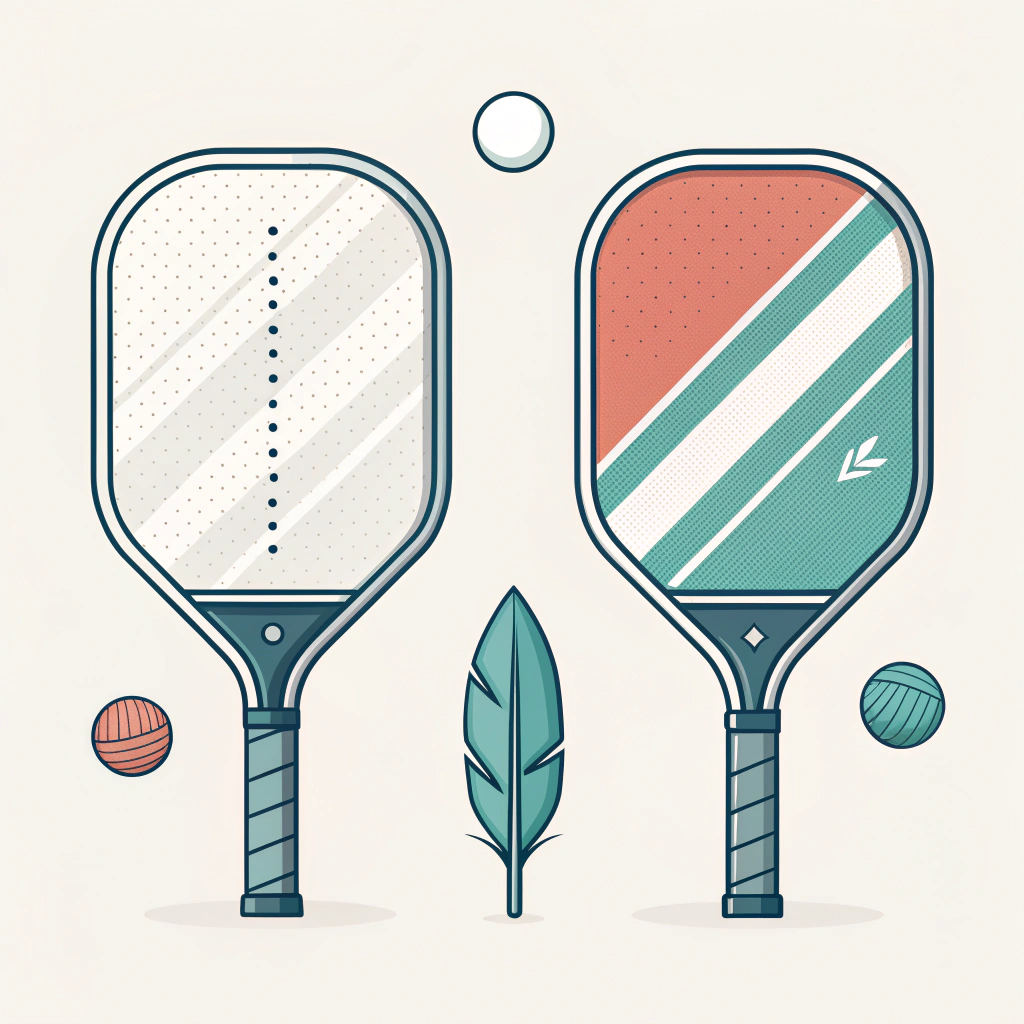
Recommended weight and balance bands (practical spec ranges)
Use these bands when drafting SKU families or OEM spec sheets. Values in grams and ounces.
- Ultralight: 170–185 g (6.0–6.5 oz) — for elite speed players; highest maneuverability; narrower market.
- Lightweight: 186–207 g (6.6–7.3 oz) — the prime speed-focused segment; good balance of control and some power.
- Midweight (for comparison): 207–235 g (7.3–8.3 oz) — best general-purpose; broader market appeal.
- Heavy: >235 g (>8.3 oz) — power-focused customers.
Balance point guidance (measured from butt end)
- Head-light: 25–28 cm (9.8–11.0 in) — maximizes swing speed and wrist control.
- Neutral: 28–30 cm (11.0–11.8 in)
- Head-heavy: >30 cm (>11.8 in) — drives power but reduces agility.
Suggested target for speed-focused SKU:
- Weight: 186–200 g (6.6–7.1 oz)
- Balance: head-light to neutral (25–29 cm)
- Thickness: 12–13 mm for players who want some stiffness without losing speed (thinner paddles = more apparent power but higher stiffness; see section below)
Use this block as an OEM micro-spec for a speed model:
- Target weight: 192 ± 4 g
- Balance point: 27.5 ± 0.8 cm
- Face: 3K carbon fiber or carbon/fiberglass composite
- Core: Polymer honeycomb (for lower vibration) or thin aluminum honeycomb if a slightly firmer feel is desired
- Overall thickness: 12.0–13.0 mm
- Surface texture: medium-grit for spin control
- Tolerance: weight ± 4 g, balance ± 0.8 cm
Materials and core choices that favor speed
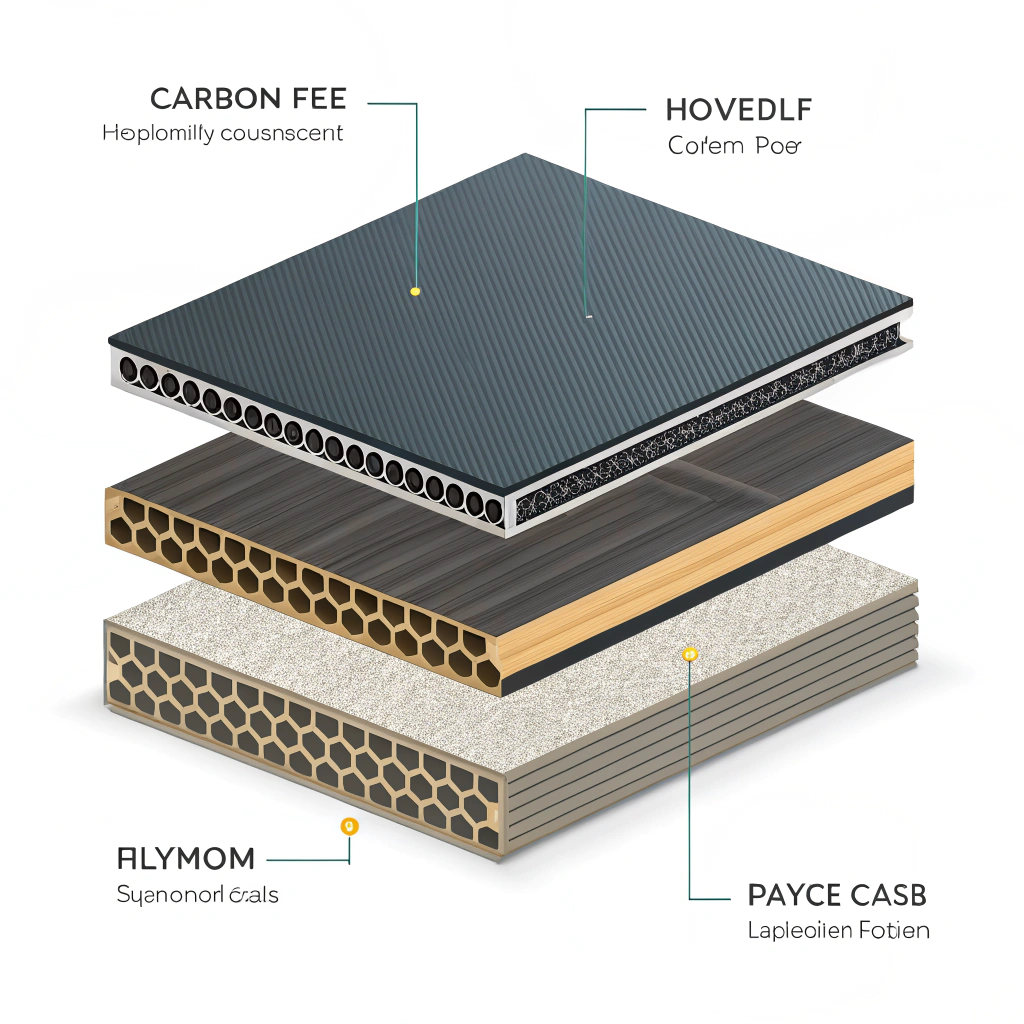
- Carbon Fiber (3K, T300, 12K)2: Carbon faces (3K or T300) deliver high stiffness-to-weight ratio, allowing thin face laminates that keep weight low while maintaining rebound and crisp feel. 3K often gives a good balance of response and surface grip; T300 is a high tensile option for strength at low thickness.
- Fiberglass: Slightly heavier and more flexible than carbon; increases feel and sweet spot size but may reduce peak swing speed potential. Consider carbon/fiberglass composites for blended behavior.
- Polymer Honeycomb Core3: Low-density polymer cores provide elasticity and reduced vibration; they enable lighter paddles with a comfortable feel.
- Nomex or Aluminum Honeycomb Cores: Nomex adds durability and a firm response (often heavier); aluminum provides a balanced weight/power trade-off but can increase overall mass.
Material recommendations for speed-focused paddles
- Primary face: 3K Carbon Fiber or T300 for stiffness with minimal weight.
- Composite option: 3K carbon + thin fiberglass layer to broaden sweet spot without adding significant mass.
- Core: High-density polymer honeycomb (thin cell walls) for a light but forgiving core.
- Shell manufacturing: aim for thinner face plies (e.g., 2–3 plies of carbon depending on ply type) and controlled core thickness.
Manufacturing processes: implications for lightweight paddle production
- Hot Pressing
- Advantages: high throughput, strong bond between layers, consistent thickness. Good for scaled production of lightweight paddles if process parameters are optimized to avoid over-curing (which can increase stiffness unpredictably).
- Disadvantages: higher capital cost; thermal cycles can slightly increase overall paddle stiffness if not tuned, affecting feel.
- Cold Pressing4
- Advantages: maintains material properties and can yield a more responsive feel; good control over thickness and ply consolidation, which helps with ultra-lightweight designs.
- Disadvantages: slower throughput; more expensive per unit but superior control for premium speed models.
- Thermoforming
- Advantages: ideal for complex shapes, edge profiles, and precise local thickness control (useful for tuning sweet spot vs. weight).
- Disadvantages: longer cycle times; higher tooling cost—best for premium or custom runs.
Manufacturing guidance:
- For a speed line with moderate volume, consider hybrid workflow: cold pressed core and face stacks for the critical laminates, then hot pressing for final cure to improve throughput while retaining feel.
- For ultra-light premium models, prioritize cold pressing4 + precise layup to control weight within ±4 g.
Production process table (quick reference)
| Process | Consistency | Best for | Cost per unit | Notes |
|---|---|---|---|---|
| Hot Pressing | High | Volume runs | Medium-Low | Tune cure to avoid over-stiffness |
| Cold Pressing | Medium-High | Premium feel/lightweight | Higher | Better thickness control |
| Thermoforming | High (shape) | Complex shapes/custom | High | Use for elongated/unique heads |
Design variables to control for speed performance
- Moment of inertia (MoI): Lower MoI = faster acceleration. Control MoI by reducing head mass and shifting balance toward the handle.
- Sweet spot size: Use face layup and composite layers to widen sweet spot without adding much mass. Carbon/fiberglass combos help.
- Thickness (mm): Thinner (≤13 mm) paddles often feel stiffer and can deliver faster ball exit if face stiffness is high. But too thin increases vibration—balance with polymer core or damping handle design.
- Grip and ergonomics: A slightly smaller grip (e.g., 4.0 in circumference) can improve wrist action and perceived maneuverability for speed play, but offer alternative grip sizes in the SKU family.
Testing, QA and acceptance criteria to include in OEM contracts
Include measurable, repeatable tests and tolerances in RFPs:
Performance tests
- Mass check: ±4 g tolerance per paddle; sample size: 5% per production lot.
- Balance point: ±0.8 cm tolerance; same sample policy.
- Ball exit speed: Use standardized swing robot or mechanical pendulum test comparing a baseline paddle—expect lightweight model to show higher exit velocity per swing speed metric.
- Swing acceleration: Measure angular acceleration with IMU5 in prototype stage to validate lower MoI benefits.
- Vibration / shock: Measure peak acceleration transmitted to handle during standard impact; polymer cores should reduce low-frequency peaks.
- Durability: 10,000–20,000 impact cycles at specified force; check delamination, face cracking.
- Edge guard adhesion, grip integrity, and print durability (for on-demand-print) to spec (e.g., 72-hour salt spray optional for coastal markets).
Acceptance tolerances (example)
- Weight: ±4 g
- Balance point: ±0.8 cm
- Thickness: ±0.3 mm
- Visual defects: none in printing area; minor cosmetic allowed in back face only
MOQ and lead time considerations
- Lightweight paddles often require tighter process controls and may have slightly higher scrap. Expect MOQ increases for premium cold-pressed lines (e.g., 1,000–3,000 units per SKU) versus hot-pressed lines (3,000–10,000+).
- Lead time: 8–16 weeks typical depending on tooling and order size; premium thermoforming or custom printed batches may add 2–4 weeks.
Cost implications and margin planning
- Face materials (carbon) and controlled pressing processes increase per-unit cost. Expect material/process premium of 10–30% vs basic fiberglass midweight models.
- Pricing strategy: position lightweight speed models at a higher ASP (average selling price) aimed at performance-focused buyers; offer a baseline midweight SKU for mass market.
Procurement-ready spec checklist (copy into RFQ)
- SKU name and target audience
- Target weight and tolerance (g/oz)
- Target balance point and tolerance (cm/in)
- Face material and ply schedule (e.g., 2-ply 3K carbon + 1 thin fiberglass)
- Core type and thickness (polymer honeycomb, 12.5 mm nominal)
- Press method (cold/hot/thermoforming) and QC steps
- Surface texture specification (grit number or roughness)
- Grip size and wrapping details
- On-demand print specs (file format, color gamut, adhesion test)
- Testing protocol and acceptance criteria
- MOQ and lead time expectations
- Sample policy and pre-production approval (PPA) requirement
Decision guide: when to add lightweight paddles to your line
- Add them if your target customers include competitive players, clubs, and performance-focused retailers and you can support higher ASPs and slightly higher production costs.
- Delay or limit to a niche test SKU if your market is largely recreational retail seeking durability and price sensitivity.
- Use a three-tier product family: one lightweight speed model (186–200 g), one midweight all-rounder (207–225 g), and one durable economy model (>225 g) to cover market segments.
Conclusion and next steps
Lightweight paddles are a strategic addition for speed-focused lines when specified and manufactured correctly. Provide your OEM (such as NEX Pickleball) with clear target weight/balance bands, material layups, pressing process preferences, and robust QA protocols. Request pre-production samples for swing-speed and durability testing, and set realistic MOQ and lead-time expectations. With the right specs, lightweight models can differentiate your offering, appeal to high-value players, and command higher margins without sacrificing product reliability.
People Also Ask
Is it better to have a lighter pickleball paddle?
A lighter paddle (≤7.3 oz / ~207 g) improves maneuverability and allows players to reach higher swing speeds with the same effort, which benefits reaction time and control in fast exchanges. However, lighter paddles typically produce less passive momentum at impact, so they may deliver less unassisted power than heavier paddles. The optimal choice depends on your target player: speed- and control-focused players prefer lighter paddles, while players seeking maximum power may prefer midweight to heavier models.
Why do thinner pickleball paddles have more power?
Thinner paddles (often ≤13 mm) tend to feel stiffer at impact because there is less material to flex and absorb ball energy. With a stiff face and thin profile, less energy is dissipated into deformation, so more is returned to the ball, which can increase ball exit velocity. That effect depends on face stiffness and core type—using a stiff carbon face over a thin core amplifies this effect, while a more elastic polymer core will reduce it.
-
moment of inertia: Read to understand how mass distribution affects paddle acceleration and handling, how to measure MoI for product validation, and why shifting balance toward the handle reduces rotational resistance. Return to moment of inertia. ↩
-
Carbon Fiber (3K, T300, 12K): Read to learn the differences between common carbon weaves/grades (3K vs T300 vs 12K), how ply count and weave affect stiffness-to-weight, and selection guidance for speed-focused face layups. Return to Carbon Fiber (3K, T300, 12K). ↩
-
Polymer Honeycomb Core: Read to learn how polymer core cell geometry, density, and wall thickness influence vibration damping, weight, and perceived feel—critical when targeting ultra-light paddles. Return to Polymer Honeycomb Core. ↩
-
Cold Pressing: Read to compare cold vs hot press workflows, understand trade-offs in throughput vs. tactile feel, and get best-practice process controls for minimizing weight variance and avoiding over-curing. Return to Cold Pressing. ↩ ↩2
-
IMU: Read to see how inertial measurement units are used in prototype testing to quantify angular acceleration and validate lower MoI benefits, plus guidance on sensor placement and data interpretation. Return to IMU. ↩