Skip to content

Short answer: Yes — paddle face material1 has a direct, measurable impact on power, control, spin, durability, weight distribution, manufacturability and unit cost. For OEM/spec decisions: choose carbon fiber2 faces for top-tier power, stiffness and spin; fiberglass faces for balanced control and wider sweet spots at lower cost; composite faces (carbon + fiberglass or hybrid laminates) when you need a tuned blend of power, feel and manufacturability. Match the face to core type and production process (hot-press / cold-press / thermoforming) and specify surface treatment and testing in your RFP to avoid surprises.
Why this matters for procurement
- Your procurement decision on face material defines the paddle’s market positioning, retail price, return rate and rework risk.
- Technical buyers need clear, spec-ready comparisons that translate into cost, volume yield, lead time and test criteria — not just marketing claims.
Who this note is for: procurement/product managers at sporting-goods brands, distributors or OEM buyers comparing carbon, fiberglass, and composite faces to finalize surface specs for private-label or retailer lines.
Materials at a glance (quick comparison)
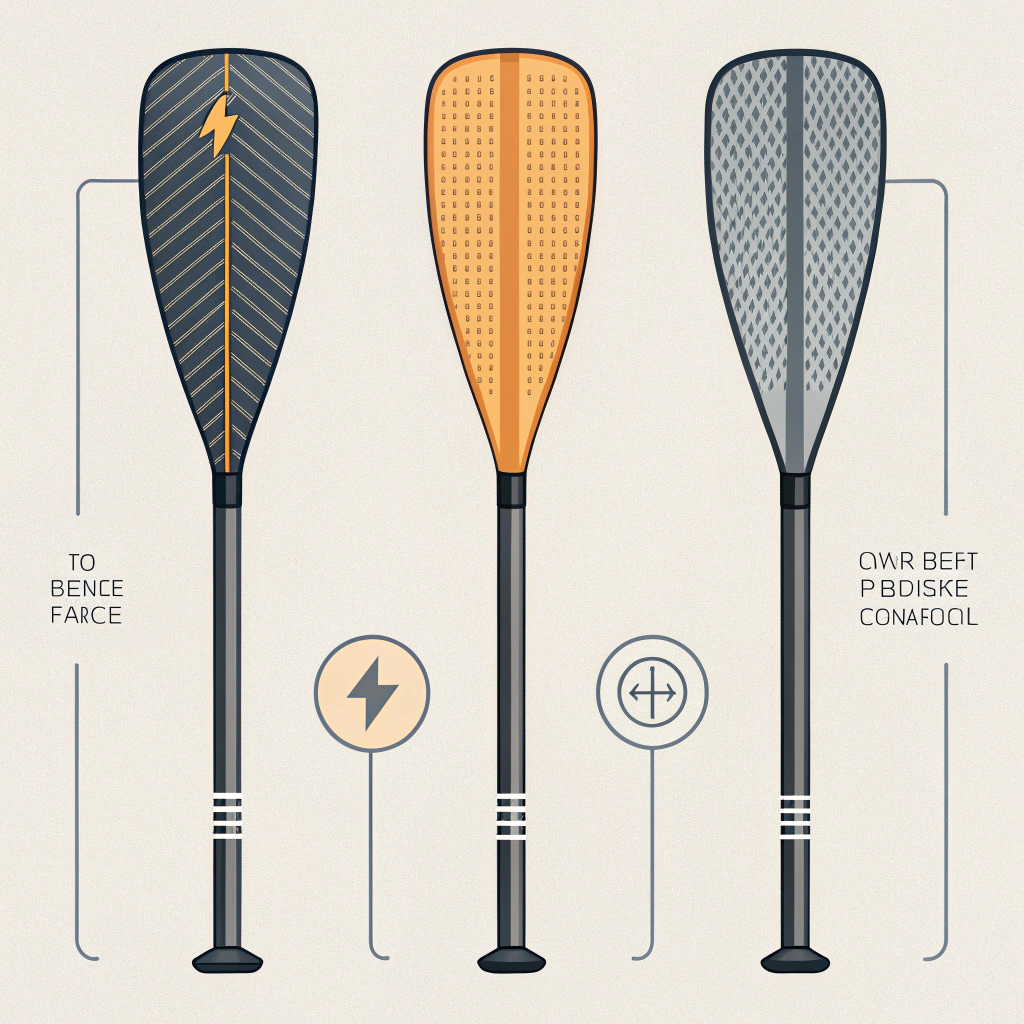
| Material (face) | Typical feel / play | Key benefits | Manufacturing notes | Best for |
|---|---|---|---|---|
| Carbon fiber (3K, 12K, T300) | Stiff, fast response, crisp pop | High power, superior durability, naturally textured for spin | Needs careful layup and curing; favored in hot-press or thermoforming for high-end paddles | Pro / Competitive |
| Fiberglass (E-Glass) | Softer, more flexible, larger sweet spot | Better control, forgiving feel, lower cost | Easier layup, tolerant of cold-press and thermoforming; paint/coat adhesion simpler | Recreational / Mid-tier |
| Composite (carbon + fiberglass, bamboo, polymer laminates) | Tunable between the two | Balanced power + control, design flexibility | Hybrid layups require precise process control and QC on adhesive interfaces | Mid-to-high tier, custom OEM lines |
Notes:
- Bold terms are used at first appearance to highlight material types.
- Carbon fiber variants (3K vs 12K vs T300) influence surface texture, stiffness and finishability. 12K gives a harder, smoother surface; 3K shows more visible twill and can be preferred for “raw weave” aesthetics.
How faces change performance (technical view)
- Energy return vs absorption: Face stiffness and resin system determine how much kinetic energy is returned to the ball. Stiffer carbon faces return more energy (more power); softer fiberglass absorbs more energy (more control).
- Spin and surface texture: A raw carbon weave or a purposely micro-textured coating increases friction between ball and face, improving spin. Smooth, glossy finishes reduce spin potential.
- Durability and abrasion: Carbon faces resist impact and abrasion better than plain fiberglass when properly laminated. Composite faces depend on the weakest interface (e.g., poor bonding between carbon layer and core shortens life).
- Weight and balance: Carbon is lighter for the same stiffness, letting you alter balance (head-light vs head-heavy) by adjusting core or added weights.
Manufacturing processes and material compatibility
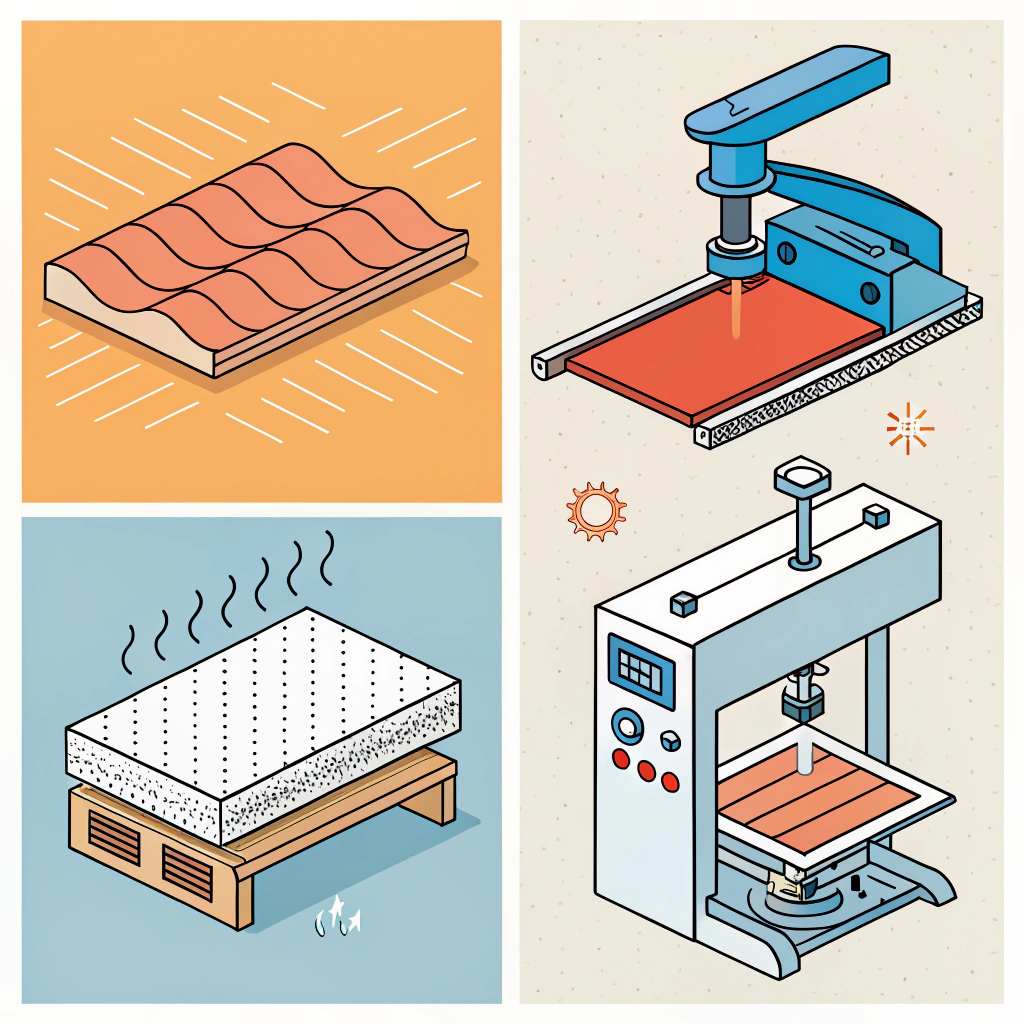
- Best for: High-volume, high-strength carbon and composite paddles.
- Pros: Short cycle time, excellent fiber-resin consolidation, consistent thickness and stiffness.
- Cons: High capital equipment, elevated temperatures may alter some resin systems and surface finish (might require post-process coating to restore texture).
- Procurement note: Specify press dwell time, temperature profile and acceptable resin systems in RFP.
- Cold-press
- Best for: Fiberglass faces and designs needing delicate control of fiber position or a softer feel.
- Pros: Preserves material hand-feel and resin chemistry, lower process thermal stress.
- Cons: Longer cycle times, needs tight pressure control to avoid voids.
- Procurement note: For carbon layers intended to keep “raw weave” look, cold-press can preserve surface texture.
- Thermoforming
- Best for: Complex shapes, multi-thickness distribution and premium/unique cosmetic designs.
- Pros: Flexibility in geometry, precise local thickness control.
- Cons: Slower, higher tooling costs; not optimal for very high volumes unless amortized.
- Procurement note: Requires front-end engineering on blank layups and vacuum/heat profile specifics.
Process-material interactions — key checks for your supplier:
- Resin cure compatibility with chosen press method.
- Adhesion between face and honeycomb core4 (polymer, aluminum, Nomex) — specify adhesive type and bonding process.
- Warpage and flatness tolerances after press/cure — include acceptable millimeter tolerances.
Surface texture, coatings and on-demand print compatibility
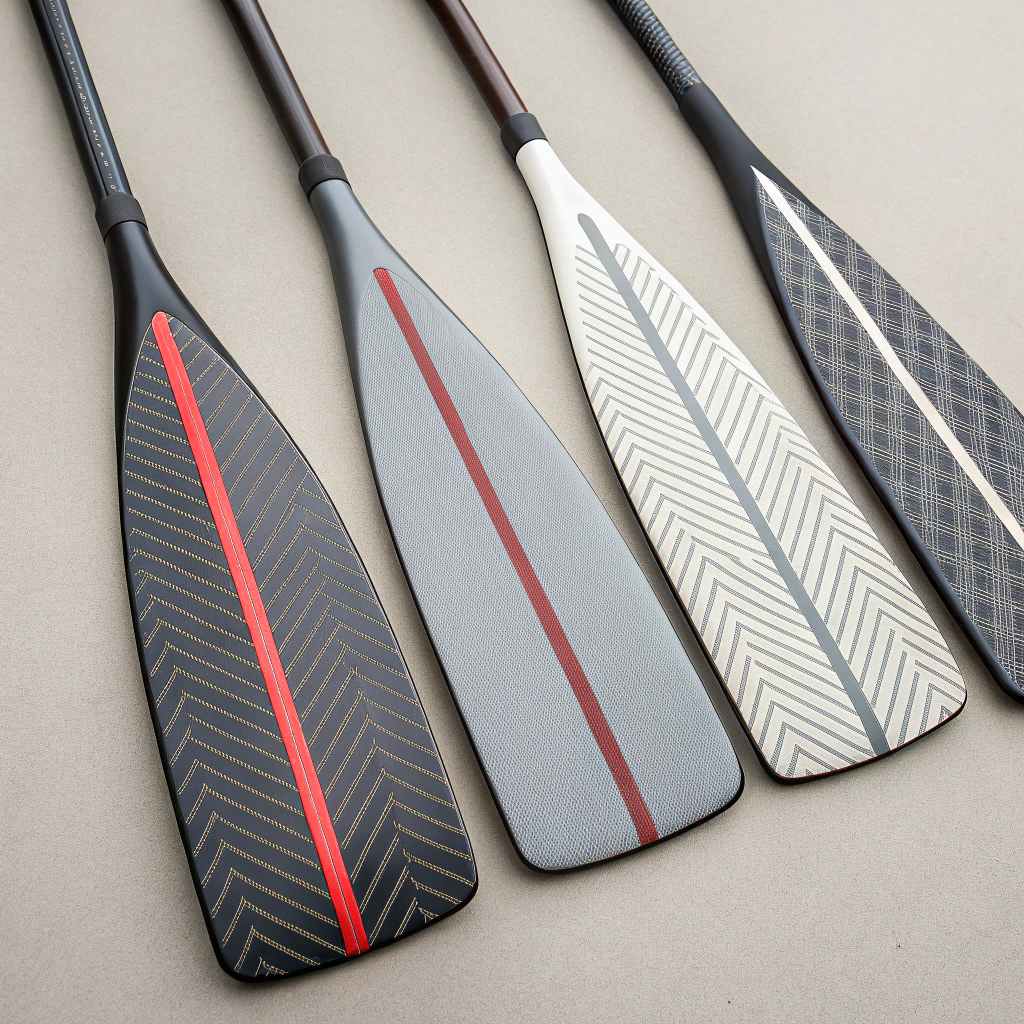
Surface choices affect spin, cosmetics and printability:
-
Raw weave carbon (no paint)
- Pros: Highest friction for spin, premium look.
- Cons: More exposed to abrasion; printing directly on raw weave reduces spin and can flake if adhesion is poor.
- RFP language: “Raw 3K twill carbon face finished with UV-resistant matte clearcoat. No additional pigment layers. Surface roughness: micro-textured to increase ball friction while allowing print adhesion.”
-
Coated matte / microtextured finish
- Pros: Controlled friction for spin, protects weave, good print adhesion.
- Typical coating: Epoxy or PU clearcoat with microfillers or sand additive to tune roughness.
- Printing: UV inks adhere well to PU/epoxy after plasma or corona treatment.
-
Gloss painted finish
- Pros: Vibrant color fidelity; easier mass customization.
- Cons: Lower spin; coatings can mask raw weave benefits.
- QC: Adhesion test (peel/ASTM equivalent), cross-cut, accelerated weathering.
Print and on-demand considerations:
- Specify whether you need direct-to-surface print, wrap, or heat-transfer. Each method has different adhesion, durability and MOQ implications.
- For on-demand printing, require a post-print scratch/peel test and a flex fatigue test to ensure no delamination under play.
Quality control checklist to include in your RFQ
- Dimensional tolerances: thickness ±0.2 mm; overall weight tolerance ±3 g (adjust by target).
- Balance tolerance: ±5 mm from target balance point.
- Visual grade: define A/B/C defect classes and allowable density per 100 paddles.
- Bonding: destructive peel test sampling (specify method) on each lot.
- Surface adhesion: cross-cut and tape tests + optional ASTM-equivalent adhesion values.
- Durability tests: Taber abrasion5 (sample size & cycles), impact resistance (measured rebound/structural integrity), flex fatigue (cycle count to failure baseline).
- Environmental: UV/weathering test for paint/coating if sold outdoors.
- Mechanical: head drop / edge impact and edge-seal integrity checks.
- Sample run acceptance: run pilot batch (e.g., 50 pieces) and verify all specs before full production.
Spec-ready templates for RFP (copy-paste)
- Pro / Competition model (example)
- Face: Carbon fiber 3K twill, outer ply; resin: high-temp epoxy compatible with hot-press.
- Core: Aluminum honeycomb, thickness 14 mm.
- Process: Hot-press cure, then CNC trimming, edge banding.
- Finish: Matte UV-resistant clearcoat + microtexture (spin-enhancing).
- Tolerances: weight 7.8 ± 3 g, thickness ±0.2 mm, balance ±5 mm.
- Tests: Peel test (lot-sample), Taber abrasion 500 cycles min, flex fatigue 100k cycles validation.
- Expected cost band: High.
- Mid-tier hybrid / retail model
- Face: Composite — carbon outer layer + fiberglass inner ply.
- Core: Polymer honeycomb, 14 mm.
- Process: Cold-press or hybrid hot/cold as required.
- Finish: PU paint base with matte topcoat. Full-surface UV on-demand print.
- Tolerances/tests: same as above but Taber abrasion 300 cycles acceptance.
- Expected cost band: Medium.
- Entry / recreational model
- Face: Fiberglass E-glass woven face.
- Core: Polymer honeycomb or foam core.
- Process: Cold-press or thermoforming for shape.
- Finish: Painted gloss finish, optional custom print via heat transfer.
- Tolerances/tests: weight tolerance ±5 g; basic QC + adhesion and buffing test.
- Expected cost band: Low.
Cost, lead time and yield considerations
- Material cost: Carbon face raw materials cost >> fiberglass. Expect 1.5x–3x material cost differential depending on weave/resin.
- Process cost: Hot-press tooling high capex but lowers per-unit time at scale. Thermoforming increases per-unit labor/tooling for complex shapes.
- Yield risks: Hybrid laminates demand tighter process control; inexperienced factories can have higher reject rates due to delamination or voids.
- Lead times: Prototype to sample ~4–8 weeks (depends on tooling). Production lead times 6–12 weeks for typical MOQ (10k+), faster if existing tooling and materials are stocked.
Recommended decision rules for procurement
- If target is pro/competition players or premium retail margin: specify high-grade carbon face, hot-press, stringent adhesion and abrasion testing.
- If you want broad market appeal and lower returns: choose fiberglass face or a carbon/fiberglass composite with protective coating.
- If customization and cosmetic fidelity (on-demand prints) are priority: plan for a PU/epoxy-compatible surface and include adhesion/print-flex testing in contract.
- Always pilot-run a minimum lot with your exact print/artwork and confirm performance tests before full production.
Case example (one-paragraph)
We recently partnered with a brand to convert an existing gloss-carbon retail paddle into a spin-focused premium line. Switching the outer layer to a raw 3K carbon + microtextured matte clearcoat and moving production from cold-press to a calibrated hot-press improved energy return by feel (player feedback) and reduced visible surface wear after 1,000 on-court cycles. The tradeoff was a modest increase in unit cost (~18%) and a 2–3 week longer tooling/setup window; yield improved once the process window was locked.
Summary + immediate procurement action
- Face material choice is a strategic decision: it affects how the paddle plays, how it ages, and how much it costs to produce.
- Use the spec templates above in your RFQ, insist on pilot-sample validation for printing and durability, and match face material to core and process to control risk.
- If you need tailored advice for MOQ, cost modelling or a pilot run specification, we can prepare a sample spec and sample batch based on your target retail price and player segment.
People Also Ask
Does pickleball paddle material matter?
Yes. The paddle’s face material determines how much energy is absorbed or returned to the ball, influencing power and feel. It also affects friction with the ball and therefore spin potential—textured carbon weaves or microtextured coatings increase spin, while smooth painted finishes reduce it. Face material also affects durability, weight distribution and how the paddle must be manufactured and finished.
Which is better carbon fiber or composite pickleball paddles?
It depends on your priority. Carbon fiber faces are generally stiffer and more powerful, and a raw carbon weave often improves spin and responsiveness for advanced players. Composite faces (carbon + fiberglass or hybrid laminates) are engineered to balance power and control—typically offering more forgiveness and a wider sweet spot. For OEM buying decisions, choose carbon for premium, high-performance lines and composites when you want a tuned balance of playability, cost and manufacturability.
-
paddle face material: Read this to get a concise overview of the different face material families, how they change play characteristics and key procurement tradeoffs (cost, manufacturability, testing requirements). ↩
-
carbon fiber: Read this to understand carbon fiber variants (weave counts like 3K/12K/T300), resin choices, layup and curing implications, plus cost and finish considerations for high-performance paddles. ↩
-
Hot-press: Read this to learn process parameters (temperature, dwell time, pressure), tooling/capex implications, typical defects to watch for, and the RFP specs you should include for consistent consolidation and thickness control. ↩
-
honeycomb core: Read this to compare polymer, aluminum and Nomex cores—differences in stiffness, weight, bonding methods and the adhesive/bondline checks you should require in supplier QC. ↩
-
Taber abrasion: Read this to understand the Taber test method, how to specify sample size and cycle counts, and how to interpret results to set acceptance criteria for face/coating durability. ↩