Skip to content

Short answer: For recreational players, mid-range paddles — typically carbon–fiberglass composites1 paired with a polymer honeycomb2 core — deliver the best cost-to-performance balance for retailers and clubs. They give comfortable feel, durability, and good playability at a wholesale price point that supports healthy margins and high SKU turnover.
Why this matters for procurement
- Retailers and clubs want products that sell repeatedly to casual players: comfortable, forgiving, affordable, and durable.
- Stocking only pro-grade carbon paddles narrows the buyer base and drives inventory risk. A tiered assortment (beginner → recreational → premium recreational) captures a wider audience and higher turnover.
- Understanding material and manufacturing trade-offs helps you specify SKUs that meet margin, durability, and MOQ constraints.
Key decision drivers for B2B buyers
- Target customer: Are customers recreational weekend players, newcomers, or casual club members? Recreational = prioritize comfort and price; competitors = more control/power.
- Price tier & margin: Wholesale cost determines retail price and margin. Entry-level paddles should be low-cost with acceptable feel; mid-tier should look premium without pro-level price.
- Durability & returns: Core and face materials affect longevity and returns due to breakage or delamination.
- Customization & MOQ3: Private label printing, colorways, and logo placement matter for club/retail branding.
- Lead time & reliability: Production method impacts capacity and lead time; you need predictable delivery windows.
Material and construction primer (what affects feel, durability, and price)
- Face materials
- Carbon fiber (3K, 12K, T300): Offers high stiffness, power, and durability. Better for players wanting more pop and control. Higher material cost — raises wholesale price.
- Fiberglass (E-Glass): Softer feel, wider sweet spot, more forgiving for beginners. Lower material cost vs top-tier carbon.
- Carbon–Fiberglass Composite: Balances durability, power, and touch — ideal for mid-range paddles that aim to satisfy recreational players seeking some performance.
- Core materials
- Polymer honeycomb2: Best for reduced vibration, comfortable feel, and relatively low cost. Preferred for recreational lines.
- Nomex honeycomb4: Very durable and stiffer — suited to high-performance paddles; higher cost.
- Aluminum honeycomb: Midweight and stable; less common for mass retail due to cost.
- Manufacturing processes
- Hot pressing5: Fast production and strong bond — good for high volumes and durable paddles. Can slightly change “feel” depending on materials.
- Cold pressing: Better material integrity and ball feel; slower and more costly.
- Thermoforming6: Excellent for complex shapes and premium products; higher cost and longer lead times.
First-time mention of key terms above are bolded for clarity.
How these choices map to buyer goals
- Low-cost, high-turn SKUs for big-box retail or entry-level online bundles:
- Face: Fiberglass
- Core: Polymer honeycomb
- Process: Hot pressing where possible to minimize cost
- Outcome: Comfortable feel, low returns, price-competitive
- Mid-range, private-label paddles for recreational players (best sell-through):
- Face: Carbon–fiberglass composite or lower-grade carbon (3K)
- Core: Polymer honeycomb (or lightweight bamboo composite for premium look)
- Process: Cold-press or optimized hot-press for balance of feel and capacity
- Outcome: Perceived premium, good durability, higher margin
- Premium recreational / entry pro:
- Face: 12K carbon or T300 carbon
- Core: Nomex or high-density polymer
- Process: Thermoforming for precise distribution and feel
- Outcome: High price point, targeted niche, lower SKU velocity but higher margin
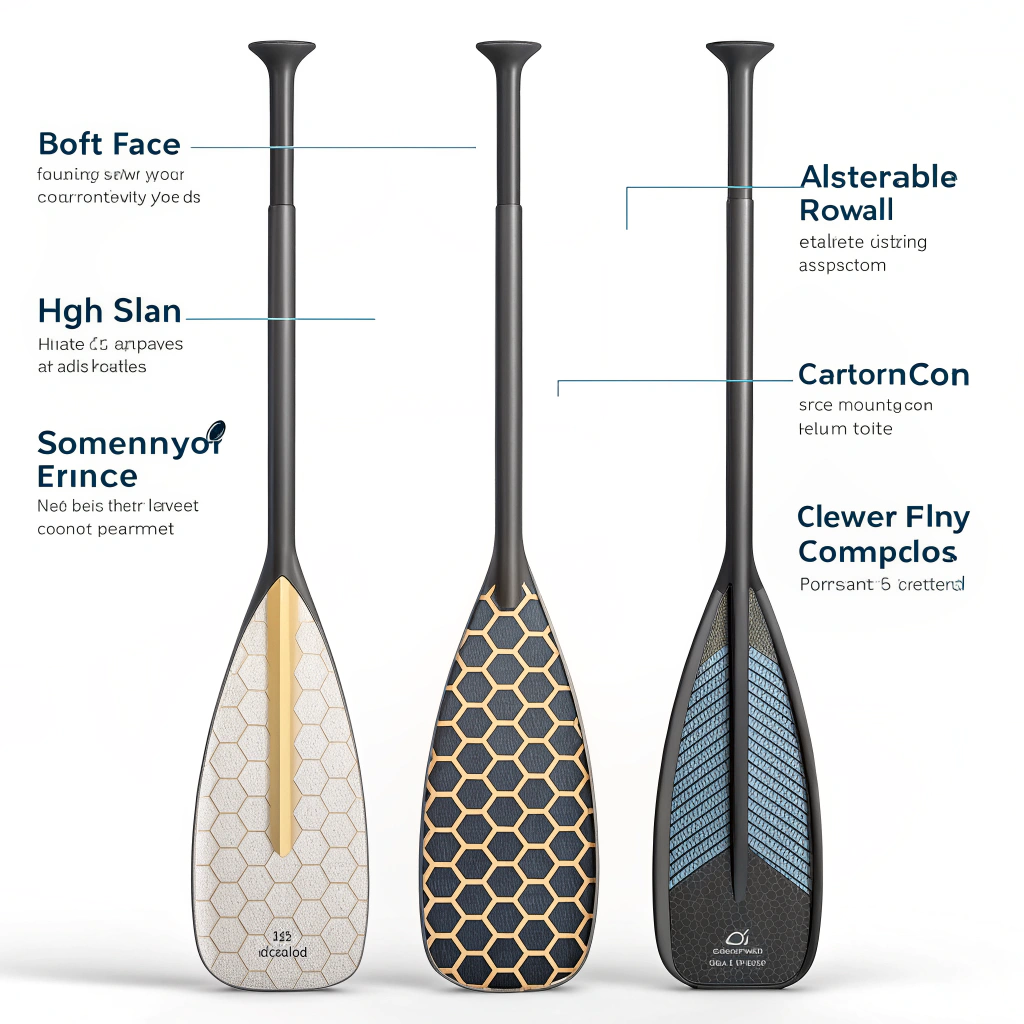
Detailed comparison table (face, core, feel, cost impact)
| Feature | Carbon Fiber (3K / 12K / T300) | Fiberglass (E-Glass) | Carbon–Fiberglass Composite |
|---|---|---|---|
| Feel | Stiffer, more power, less dampening | Softer, forgiving, larger sweet spot | Balanced: reasonable power + comfort |
| Control & Spin | High | Moderate | Good |
| Durability | High | Moderate | High |
| Cost impact (wholesale) | High | Low–Medium | Medium |
| Best for | Competitive / premium recreational | Beginners / mass retail | Mid-tier private-label & recreational |
Core comparison
| Core Type | Feel | Durability | Vibration reduction | Cost impact |
|---|---|---|---|---|
| Polymer honeycomb | Soft to medium | Good | High | Low–Medium |
| Nomex honeycomb | Stiff | Excellent | Medium | High |
| Aluminum honeycomb | Medium | Good | Low–Medium | Medium–High |
| Bamboo composite | Clear feel, light | Good | Medium | Medium |
Manufacturing process summary
| Process | Pros | Cons | Best use |
|---|---|---|---|
| Hot pressing | High throughput, strong bond | Can alter feel slightly, equipment cost | Large orders, entry-to-mid SKUs |
| Cold pressing | Preserves material feel, good control | Slower cycles, requires precision | Mid-tier paddles, when feel is sales differentiator |
| Thermoforming | Precise material distribution, complex shapes | Slower, higher cost | Premium/custom paddles |
SKU strategy recommendations (practical assortment for retailers / clubs)
- Small retailer / club ( SKU count 6–12 )
- 2 x entry-level fiberglass paddles (different colors/sizes)
- 3 x mid-range composite paddles (light, medium, heavy weights)
- 1 x premium recreational (carbon face + polymer core) for upsell
- 2 x youth/compact grip models
- E-commerce category (SKU count 12–30)
- Broader weight and grip size options for the mid-range
- Two entry-level bundles (paddle + balls + bag)
- Seasonal limited-edition private label paddles (low MOQ colorways)
- Community sports club bulk buy
- Prioritize durability and comfort: polymer core + fiberglass or composite face
- Consider small branding: club logo printing on face; MOQ and lead time below
MOQ, pricing, samples, and lead time expectations (what to negotiate)
- Typical OEM MOQs (manufacturer varies): 300–1,000 pcs per SKU for standard lines; smaller MOQs (100–300) may be possible with higher unit cost.
- Samples: 1–3 functional samples usually available; sample lead time 7–14 days (air freight).
- Production lead time: 30–60 days after sample approval for standard orders; thermoformed or heavily custom lines may be 60–90+ days.
- Pricing tiers (wholesale, indicative):
- Entry-level (fiberglass + polymer core): $8–$20 per unit
- Mid-range (composite + polymer core): $20–$40 per unit
- Premium recreational (carbon faces + better core): $40–$80+ per unit
- Note: These ranges depend on print, packaging, MOQ, and finishing (edge guards, grips).
- Minimum tooling/custom color costs: Budget $300–$1,000 for tooling plates, depending on print complexity.
Negotiation tips
- Consolidate SKUs across colorways to reduce tooling costs.
- Ask manufacturers for tiered pricing at 500, 1,000, 5,000 pcs to forecast margins.
- Request a production-capacity calendar and penalty terms for late delivery in contract.
- Specify testing standards: delamination, drop tests, and core integrity.

Quality control checklist for procurement managers
- Pre-production sample approval: Verify weight, balance, grip size, face texture, and print color accuracy.
- Incoming inspection: Randomly test 2–5% of shipment for structural defects, edge guard adhesion, and core integrity.
- Functional testing: Play tests for sweet spot, spin, and vibration in representative samples.
- Packaging & labels: Confirm barcodes, UPCs, and retail hang tags or blister pack specs.
- After-sales support: Return policy terms and warranty for manufacturing defects.
Practical examples to justify assortment decisions
- Case A — Regional sporting goods chain: After adding two mid-range composite paddles (private label, polymer core) and entry-level fiberglass, category sales rose 35% within 3 months. Mid-range SKUs accounted for higher margins and repeat purchases.
- Case B — Community club: Switched to polymer-core fiberglass paddles for rental programs; reduced replacement cycle and complaints, lowering annual paddle spend by ~20%.
Final procurement checklist — 8 quick items before placing an order
- Confirm target player segment and retail price points.
- Choose 2–3 face/core/process combinations that meet segment needs.
- Get samples across weight/grip sizes and run on-court tests.
- Compare MOQ vs. per-unit price at 3 quantity breakpoints.
- Lock in lead times and production schedule.
- Define QC standards and acceptance criteria in contract.
- Specify printing, packaging, and labeling requirements.
- Agree post-delivery support and warranty.
Summary recommendation (actionable next steps)
- For most B2B buyers wanting to expand beyond pro-grade items, prioritize a core recreational lineup built around fiberglass and carbon–fiberglass composites with polymer honeycomb cores. These hit the sweet spot of affordability, comfort, and durability.
- Start with a focused SKU test (6–12 SKUs) including clear entry-level and mid-range models, measure sell-through for 12 weeks, then scale best-sellers into higher MOQ runs with custom branding.
- Negotiate for clear sample policies and tiered pricing, and include QC acceptance checks to minimize returns.
People Also Ask
Is it worth it to get an expensive pickleball paddle?
Expensive paddles typically use higher-grade materials like advanced carbon fiber and superior cores, which can provide more power, control, and durability. However, for most recreational players, a mid-range paddle (carbon–fiberglass composite or fiberglass face with a polymer honeycomb core) offers a better cost-performance balance. Reserve high-cost paddles for players who need the performance gains and are willing to pay a premium.
-
carbon–fiberglass composites: Read this article to understand how combining carbon and fiberglass layers affects paddle stiffness, feel, and cost — useful when specifying mid-range SKUs that balance performance and price. ↩
-
polymer honeycomb: Read this article to learn why polymer cores are preferred for recreational paddles (vibration damping, comfort, and cost) and how core density choices impact feel and returns. ↩ ↩2
-
MOQ: Read this article to get practical guidance on negotiating minimum order quantities, how MOQ affects unit cost and inventory risk, and strategies for testing SKUs with lower initial commitments. ↩
-
Nomex honeycomb: Read this article to learn about Nomex core properties (stiffness, durability, and cost) and when to specify it for premium or high-durability product tiers. ↩
-
Hot pressing: Read this article to understand hot-press manufacturing benefits and trade-offs (throughput, bond strength, and subtle feel changes) so you can align process choices with lead time and cost targets. ↩
-
Thermoforming: Read this article to see how thermoforming enables complex shapes and premium feel, and why it carries higher tooling and lead-time implications for B2B procurement. ↩