Skip to content

Short answer: For most OEM product lines, choose thickness based on player target — 12–13 mm for power-focused beginners/intermediates, 14 mm as a balanced all-rounder, and 15–16 mm for control-oriented or advanced players. Thickness interacts with core material1, face stiffness, and manufacturing method2; specify those three together in SKU briefs to get predictable on-court behavior and consistent manufacturing yields.
Why thickness matters (quick framing)
- Paddle thickness primarily controls the paddle’s effective stiffness, vibration absorption, and distance between the face and the core center — all of which affect power vs control, sweet spot size, and feel.
- Thickness is not an isolated spec: the same thickness with a polymer honeycomb3 core will feel different from one with a Nomex4 core or an aluminum core. Surface material (fiberglass vs different carbon fiber weaves) and weight distribution further change perceived power and control.
- Problem description: the buyer’s dilemma
Product managers must pick thicknesses for a new SKU set that:
- Hit clear market segments (beginner → pro).
- Balance manufacturing cost, cycle time, and tolerances.
- Ensure on-court performance is reproducible across batches.
Common mistakes:
- Specifying thickness alone without core type and face layup.
- Expecting more thickness always equals more control.
- Ignoring production implications (tooling, press time, QC rates).
- How thickness affects play — plain engineering
- Thicker core → increased paddle depth → higher bending stiffness for the same face material and core density. This tends to:
- Reduce deformation on impact → less energy returned to ball (perceived lower “pop”) → more control and better blocks/resets.
- Increase dwell time and absorption → better soft shots/drop shots.
- Thinner core → more flex → higher rebound → more power, faster shots, but potentially less control.
- Sweet spot: thickness plus face stiffness and core cell size determine effective sweet spot. A stiffer face (e.g., 12K carbon) can widen perceived sweet spot even on a thinner core.
- Weight distribution: thicker cores often shift the mass slightly away from the face center; balance with handle weight to keep desired moment of inertia (MOI).
- Core material interactions — quick guide
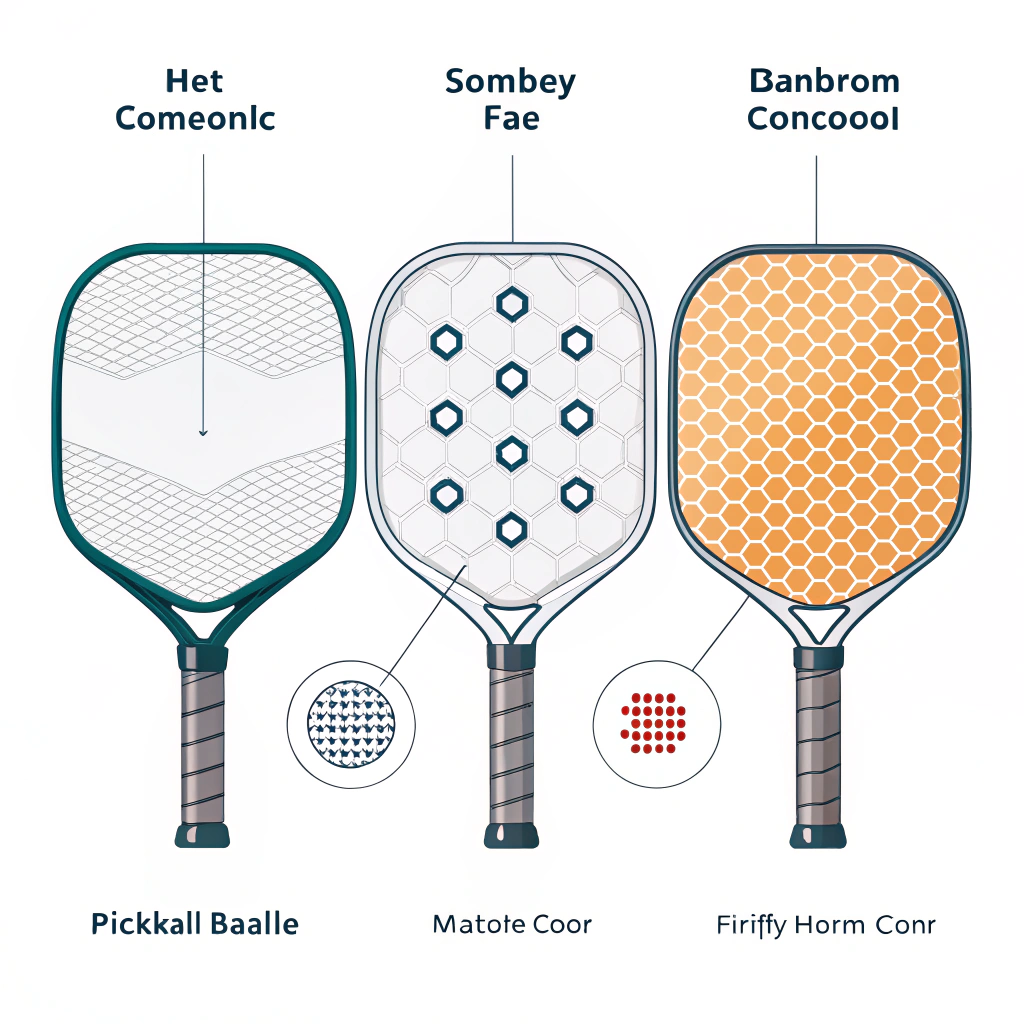
- Polymer honeycomb core:
- Feel: softer, more elasticity, reduced vibration.
- Use: recreational & mid-level paddles where comfort and forgiveness matter.
- Manufacturing: compatible with cold pressing and thermoforming; forgiving tolerances.
- Nomex honeycomb core:
- Feel: very stiff, crisp, high rebound.
- Use: competitive / performance paddles seeking durability and consistent pop.
- Manufacturing: often requires hot pressing5 for proper resin cure and strong bonding.
- Aluminum honeycomb core:
- Feel: balanced, slightly higher weight for same thickness, excellent structural strength.
- Use: niche high-power designs; suitable where stiffness and stability are prioritized.
- Manufacturing: requires process control to avoid face deformation during bonding.
- Production method impact on thickness and feel
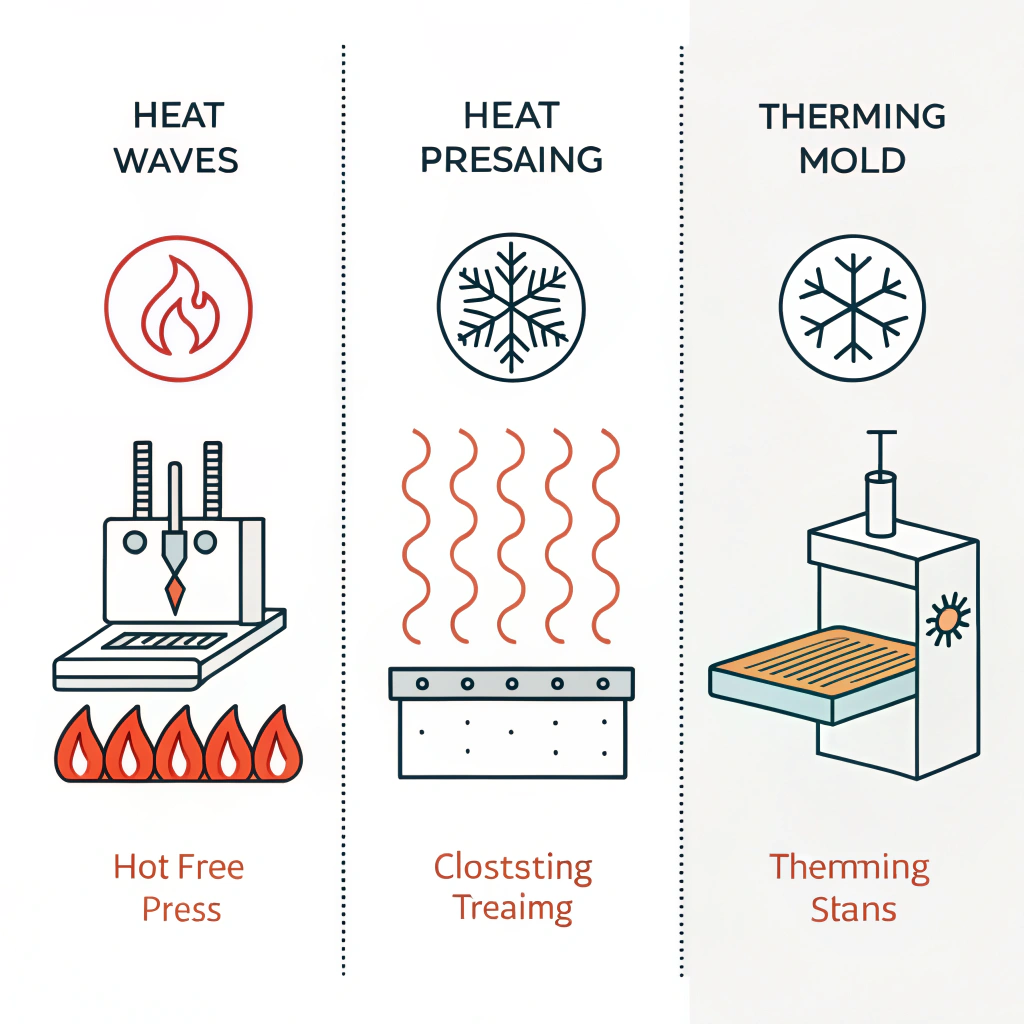
- Hot pressing:
- Pros: fast cycles for high-volume; creates strong bonds and consistent thickness under pressure+heat.
- Cons: can change resin/crystallinity slightly — some players report different feel; high CAPEX.
- Best for: Nomex/aluminum cores and high-volume carbon-face paddles.
- Cold pressing:
- Pros: preserves raw material properties, yields better tactile “feel”; precise thickness control feasible.
- Cons: slower cycles, lower throughput.
- Best for: polymer-core paddles and models targeted for feel/control.
- Thermoforming:
- Pros: excellent for complex shapes and variable thickness panels (edge tapering, targeted sweet-spot zones).
- Cons: longer cycle times and tooling cost — ideal for premium/custom runs.
- Recommended thickness-by-segment (actionable SKU table)
The table below pairs thickness with recommended core, face, weight target, manufacturing method, and expected player perception.
| Target player | Thickness (mm) | Core type | Face material | Weight (oz / g) | Production method | Perceived play |
|---|---|---|---|---|---|---|
| Beginner / Rec | 12–13 | Polymer honeycomb | Fiberglass or 3K carbon | 7.6–8.2 oz (215–235 g) | Cold press / thermoforming | More power, forgiving |
| Intermediate | 13–14 | Polymer or Aluminum | 3K carbon or 3K+fiberglass composite | 7.4–7.9 oz (210–225 g) | Cold press / hot press | Balanced power/control |
| Advanced / Club | 14–15 | Polymer or Aluminum | 12K carbon or carbon-fiberglass composite | 7.2–7.8 oz (205–220 g) | Hot press or thermoforming | Balanced with more control |
| Competitive / Pro | 15–16 | Nomex or Aluminum | 12K / T300 carbon | 7.0–7.5 oz (200–215 g) | Hot press | High control, crisp response |
Notes:
- Weight ranges are mass-in-hand targets; specify +/- 4 g tolerance for consistent feel.
- For junior models reduce length/weight accordingly and maintain the same thickness-to-core pairing.
- Manufacturing and QA tolerances you should specify
- Thickness tolerance: ±0.3 mm or tighter for premium SKUs; ±0.5 mm acceptable for low-cost lines.
- Flatness/warpage: <0.5 mm across paddle face after assembly.
- Bonding strength: peel test > industry baseline (specify your number; NEX can provide test data).
- Cell integrity for honeycomb: maximum visible crush rate per sample batch.
- Design variations that help tune performance without changing nominal thickness
- Edge taper: thinning the rim by 0.5–1.0 mm increases sweet spot forgiveness while preserving core depth.
- Variable thickness zones: use thermoforming to create a thicker central zone for control and thinner perimeter for maneuverability.
- Face layup tuning: a softer fiberglass face on a 14 mm polymer core produces a more forgiving feel than carbon; conversely, stiffer carbon faces amplify control on thicker cores.
- Cost, throughput and tooling considerations
- Hot pressing gives lower per-piece time at scale but needs higher initial tooling/CAPEX—good for large MOQ runs.
- Cold pressing reduces upfront heat-resistant tooling but has longer cycle time—better for prototyping, premium smaller runs.
- Thermoforming increases per-unit labor and tooling complexity; reserve for premium lines or custom orders with higher ASP.
- MOQ guidance: for custom face artwork/printing and new tooling: 3,000–5,000 pcs per SKU is common to amortize costs; ask NEX for a specific quote — they support on-demand-print services for smaller promotional runs.
- Practical brief template you can copy into RFQ / Tech Pack
- Nominal thickness: 14.0 mm ±0.3 mm
- Core: Polymer honeycomb, cell size X mm, density Y g/cm3
- Face: 12K carbon, UV-cured epoxy layup, 3 plies
- Edge: 2.5 mm ABS edge guard, tapered rim -0.7 mm at 2 cm from tip
- Weight target: 7.6 oz ±4 g
- Balance point: 32–34 cm from butt
- Manufacturing: Cold press for first 2,000 pcs; then hot press for scale
- Tolerances / tests: Flatness <0.5 mm; peel strength >Z N; bounce/rebound test per NEX standard
- Limitations & trade-offs (what to expect)
- Thicker paddles with Nomex will be durable and controlled but can feel harsh to some recreational players; blending a thin layer of fiberglass or softer face material can compensate.
- Ultra-thin paddles (<12 mm) will boost power but sacrifice control and may not meet durability expectations for heavy use.
- Variable thickness designs increase tooling complexity and QC needs — expect higher reject rates during early production.
- Case support & quick decision checklist
- If you need a balanced starter kit for retail (wide audience): prioritize a 13–14 mm polymer-core, fiberglass/3K composite face, mid-weight.
- If building a high-end competitor line: select 15–16 mm with Nomex core + 12K/T300 carbon face; use hot pressing and stricter tolerances.
- If your club or distributor requires durable, mid-power paddles that are comfortable for frequent play: consider 14 mm polymer core + edge taper + cold press.
Summary — suggested SKU set for a coherent line (example)
- SKU A (Recreational): 13 mm, polymer core, fiberglass face, 7.8 oz, cold press.
- SKU B (All-rounder): 14 mm, polymer/aluminum hybrid core, 3K carbon+fiberglass face, 7.6 oz, cold press.
- SKU C (Performance): 15 mm, Nomex core, 12K carbon face, 7.3 oz, hot press.
Include clear tolerance and manufacturing method in RFQ to avoid surprises.
People Also Ask
What is the best thickness for a pickleball paddle?
- There is no single “best” thickness — it depends on the player and design goals. For most lines, 12–13 mm favors power and a lively feel (good for beginners), 14 mm is a balanced all-round choice, and 15–16 mm gives more control and better blocking/reset feeling for advanced or competitive players. Always pair thickness with core type and face layup when specifying.
What is the benefit of a thicker pickleball paddle?
- Thicker paddles generally increase stiffness and energy absorption, which reduces rebound power and improves control on blocks, drops, and resets. A thicker core also dampens incoming pace, making defensive shots easier. The net effect depends on the core material: a thick polymer core is softer than a thick Nomex core, so list both thickness and core in your specs.
-
core material:Read the article to see how different core materials (polymer, Nomex, aluminum) change stiffness, weight, damping, and durability — and how to specify core type, density, and cell size in RFQs to control on-court performance and manufacturing outcomes. ↩
-
manufacturing method:Read the article to understand hot pressing, cold pressing, and thermoforming trade-offs (CAPEX, cycle time, effect on resin cure/feel, and when each method is appropriate) so you can match process to product targets and MOQ. ↩
-
polymer honeycomb:Read the article to learn why polymer honeycomb cores are forgiving in tolerance and feel (softer rebound, better vibration damping), which markets they suit, and how they affect press choice and QC limits. ↩
-
Nomex:Read the article to understand Nomex core characteristics (high stiffness, crisp pop, durability), why it often requires heat/press control, and how to balance harshness with face layups for recreational vs pro lines. ↩
-
hot pressing:Read the article to get practical guidance on hot-press process parameters, tooling/CAPEX implications, expected cycle times, and how hot pressing influences resin crystallinity and the perceived “feel” of carbon-face paddles. ↩