Skip to content

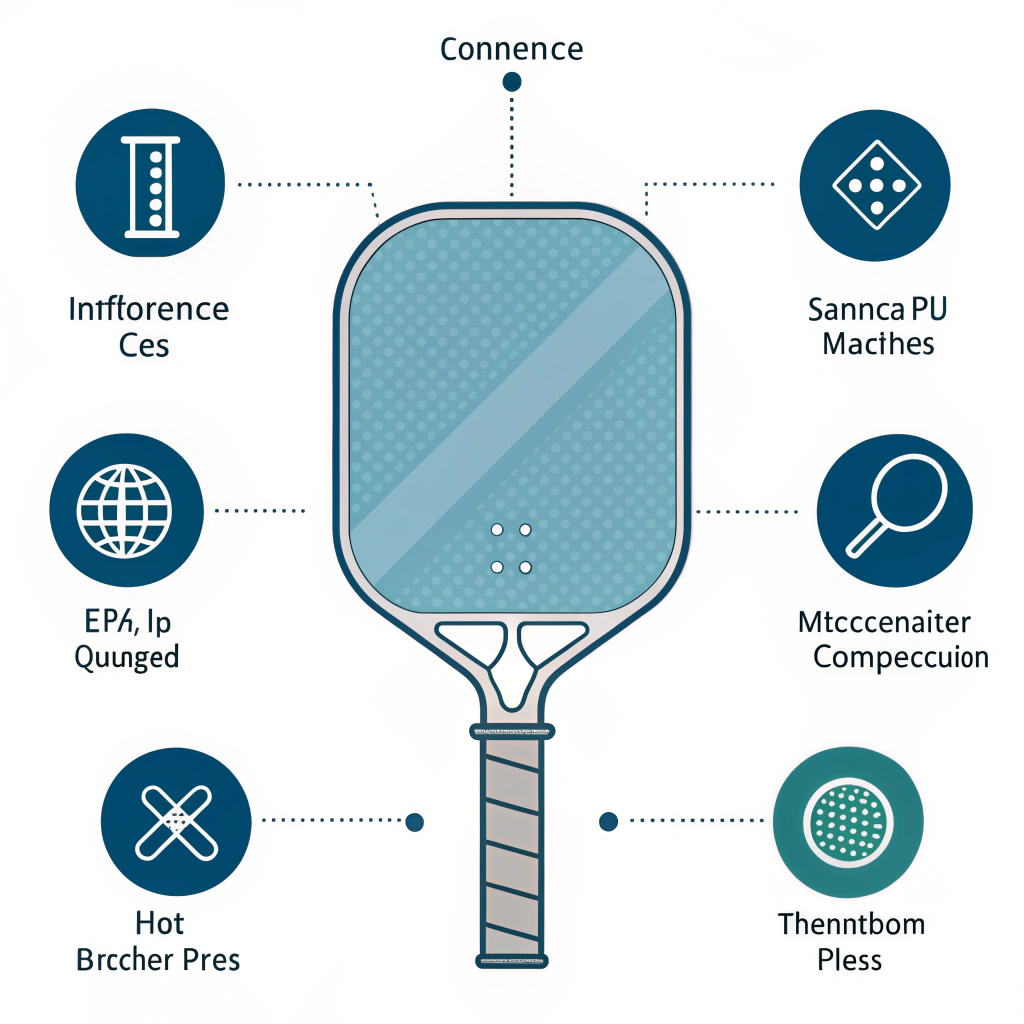
Quick answer: For OEM/ODM pickleball paddles, specify a clear, measurable handle ergonomics1 package — including grip circumference, grip length, taper profile, grip material, and tolerance — matched to your target player hand size and manufacturing process (hot press, cold press, or thermoforming). Use a short, testable QC checklist (dimension +/- tolerances, tackiness/friction, grip compression, balance point, and durability cycles) to accept prototypes and gate mass production.
Problem: why procurement decisions stall on paddle handles
- Many brands fail to convert feel-based feedback ("too thick", "too slippery") into measurable specs. That leaves OEMs guessing and causes long prototype loops.
- Handle ergonomics influence comfort, control, injury risk, and perceived power, so a vague brief risks misaligned tooling, rework, and higher unit cost.
- Different manufacturing processes (hot pressing, cold pressing, thermoforming) change final material feel, thickness, and surface tack; you must match targets to feasible processes.
Why this matters (short list for decision-makers)
- Ergonomics drives repeat purchase: poor feel increases returns and reduces retail velocity.
- Measurable specs accelerate sampling and reduce arbitration between R&D and factory.
- Correct tolerances and testing avoid cosmetic and functional rejects that cost both time and money.
How to convert "feel" into an OEM-ready handle ergonomics spec (Solution checklist)
- Define target player / use-case
- Recreational players: prioritize cushioning, wider sweet spot, lower cost.
- Club/competitive players: prioritize control, lower vibration, precise taper.
- Two-handed backhand designs: longer grip length and slimmer taper.
- Core measurable dimensions (recommended ranges and tolerances)
Note: use either metric or imperial consistently in your spec sheet.
| Dimension | Recommended range | Suggested tolerance | Rationale |
|---|---|---|---|
| Grip circumference (measured around grip) | 100–115 mm (approx. 3.9–4.5 in) | ±1 mm | Controls how the hand wraps; smaller for smaller hands, larger for power grip. |
| Grip diameter (across grip) | 28–34 mm | ±0.5 mm | Affects finger placement and leverage. |
| Grip length (from butt cap to end of rubber overwrap) | 110–140 mm (4.3–5.5 in) | ±2 mm | Longer for two-handed backhand; shorter for wrist play. |
| Butt cap aperture diameter | 20–24 mm | ±0.5 mm | Accepts strap hardware, affects balance. |
| Taper profile (axial change over length) | 0–6 mm difference from butt to throat | ±0.5 mm | Taper influences finger seating and feel. |
| Overall paddle weight | 220–260 g | ±3 g | Affects swing speed and perceived feel. |
| Balance point (from butt) | 180–240 mm | ±2 mm | Determines head-heavy vs. handle-heavy feel. |
- Grip materials: pros, cons, and quick pick
- PU (polyurethane) wrap: high tack, good sweat resistance, medium cushioning. Best for premium retail paddles. Compatible with hot and cold press processes for attachment.
- EVA foam: softer, better shock absorption, lower cost, less tack. Good for recreational paddles.
- Microfiber overwrap: great sweat wicking and soft feel; lower tack, often layered over PU or EVA.
- Perforated wraps: improve breathability; may reduce tack slightly.
Include this compact table in your spec:
| Material | Tackiness | Cushioning | Durability | Cost | Notes |
|---|---|---|---|---|---|
| PU | High | Medium | High | Medium-High | Preferred for competition feel. |
| EVA | Low-Med | High | Medium | Low | Good for comfort-focused lines. |
| Microfiber | Low | Medium | Medium | Medium | Use as outer layer for sweat control. |
- Tactile properties and testable targets
- Tackiness / coefficient of friction (COF)2: specify a target range (e.g., static COF 0.6–0.9 vs. skin). If you request lab testing, use standard ASTM methods for skin friction or a simple peel test.
- Compression / hardness (shore A)3: specify grip hardness (e.g., Shore A 25–45) depending on softness required.
- Vibration damping: list acceptable peak acceleration reduction vs. a baseline paddle (e.g., ≤20% transmitted peak acceleration at 150 Hz). If you cannot do lab vibrometry, use player-rated scales and pass/fail thresholds during sampling.
- Manufacturing constraints and recommendations
- Hot pressing: fast, suitable for high-volume cores and stable dimension. But heat can slightly soften or change grip adhesives — request samples to verify final tack.
- Cold pressing: preserves material properties (better feel) but longer cycles. Use for higher-end paddles where touch is critical.
- Thermoforming: best for complex shapes and material distribution. Ideal for blended composite face layers and variable thickness handles but has higher tooling cost.
Mapping (quick view):
| Process | Best use for handles | Impact on grip | Production note |
|---|---|---|---|
| Hot pressing | Volume, stable core | Heat can affect adhesives and wrap fit | Use heat-stable adhesives and check tack post-press |
| Cold pressing | Premium feel | Preserves material elasticity | Longer cycle time; may raise unit cost |
| Thermoforming | Complex geometries | Good for integrated handles | Higher tooling cost; use for premium custom shapes |

- Design choices that affect feel and performance
- Taper: a gradual taper (3–5 mm over full grip) supports finger placement without abrupt change. Abrupt tapers are for specialty grip styles.
- Perforation: vents reduce sweat build-up but decrease surface tack; perfect for competition paddles with microfiber layers.
- Grip wrap thickness vs. handle core: you can trade core size for more wrap layers. If tooling expects a fixed throat diameter, note the maximum wrap thickness allowed.
- Cost & production trade-offs (short summary)
- Thicker, multi-layer wraps and microfiber/perforated finishes increase cost and assembly time.
- Cold-pressed paddles typically cost more per unit vs. hot-pressed, but may reduce returns for premium lines.
- Custom butt cap machining and metal strap inserts raise tooling and per-unit cost.
QC and testing protocols you must include in supplier contracts
Pre-production (PPAP4 / sample gate)
- Deliver 3 prototype grades: alpha (concept), beta (production tooling), and final run-of-tool sample.
- Provide CMM or digital caliper readings for all critical dimensions vs. spec table.
Incoming inspection ( AQL 2.55 & sampling)
- Use AQL 2.5 for critical dimensions and AQL 4.0 for cosmetic items for first production runs.
- Measure using digital caliper (mm) and circumference gauge (for grip wrap).
Specific QC tests (minimum recommended)
- Dimension check: grip circumference, grip length, butt cap, and taper — sample size n=5 per carton.
- Adhesion test: tape-peel at 180° after 24h cure (adhesive must meet user-defined peel strength, e.g., >2 N/cm).
- Tackiness/COF: use a portable tribometer or standard peel/friction device. Define acceptance band.
- Compression test: repeated 1000-cycle compression to 25% compression depth; measure rebound and permanent set.
- Vibration/impact: drop test or accelerometer test to compare peak acceleration transmission vs. control model.
- Sweat/durability test: 1000 simulated swings with synthetic sweat on microfiber; observe discoloration, delamination, and tack changes.
- Balance/weight: measure overall weight and balance point (± specified tolerance).
Production monitoring
- First 1000 units: 100% inspection on critical items or increased sampling.
- Monthly audit: random samples, re-run compression and tack tests, check for adhesive failure.
Sample inspection checklist (short)
- Visual: grain orientation, seam alignment, wrap overlap.
- Dimensional: circumference ± tolerance, grip length ± tolerance, taper ± tolerance.
- Functional: tackiness within band, compression test pass, no edge delamination.
How to run a practical prototype evaluation with your test team (step-by-step)
- Define three target hand sizes (small, medium, large) and map to grip circumference choices in your line.
- Request three prototypes per grip size with specified wrap material and one alternate material for A/B testing.
- Use a small player panel (6–10 players) and blind test for 20-minute play sessions; capture Likert scores on comfort, control, and perceived power.
- Run QC lab tests on the same samples: dimensional, compression, tack, and vibration.
- Compare subjective scores to measurable data and pick winners that meet both user preference and QC thresholds.
Cost-savings tip: Standardize one core handle tooling and provide optional wrap kits (PU, EVA, microfiber) to allow multiple SKUs without retooling.

Common mistakes and how to avoid them
- Mistake: specifying only "comfortable grip" without dimensions — Fix: use the dimension table and tolerance.
- Mistake: ignoring process impact — Fix: require sample verification after the intended production process (hot/cold/thermoforming).
- Mistake: only subjective testing — Fix: pair player panels with measurable QC tests.
- Mistake: too tight or too loose tolerances — Fix: set tolerances aligned with process capabilities (speak with factory on achievable ± values).
Case example (short)
- A mid-tier brand requested a "thin, tacky handle." Initial samples used hot pressing with a thick PU wrap; outcome: good tack but heavy head balance and inconsistent wrap adhesion. After switching to cold pressing with a thinner core plus microfiber outer layer, the paddle achieved preferred balance and consistent adhesion across runs — production cost rose 6% but returns dropped 45% in the first season.
Decision checklist for Procurement & R&D (what to require in RFQ)
- Target player and grip size mapping (list the hand-size groups).
- Full dimension table with tolerances (circumference, length, taper).
- Grip material spec (PU/EVA/microfiber), color, perforation, and finish.
- Manufacturing process to be used and sample verification requirement.
- QC tests and acceptance criteria (adhesion, tackiness, compression, weight, balance).
- Sampling plan, AQL, and first-article requirement.
- On-demand-print and logo tolerance if artwork applied.
Final action recommendations
- Convert your product brief into a one-page spec that contains the dimension table, material selection, and pass/fail QC tests.
- Require three production-grade samples using the intended manufacturing process before approving tooling.
- Include a clause for periodic re-testing of tackiness and adhesion (every 6 months or after a material change).
People Also Ask
Q: What makes a pickleball paddle better than others?
A: A paddle’s performance usually comes down to measurable trade-offs: thickness vs. weight (thinner paddles often deliver more pop and faster swing; thicker paddles provide more control and consistent response), core material (polymer/honeycomb vs. aluminum/Nomex affect control and vibration), face material (carbon fiber for power and responsiveness; fiberglass for a softer feel), and handle ergonomics (correct circumference, taper, and tack). Define which attributes your target player values and convert them into specs (weight, balance point, core stiffness) to compare suppliers objectively.
Q: What pickleball paddle has a lot of grip?
A: Paddles with high-grip feel combine a tacky PU wrap or textured microfiber outer layer and often include a perforated backing for sweat control. Overgrips like Tourna Original, Gamma Tac, or Prolite No-Sweat are commonly used as aftermarket options to increase tack and cushioning. For OEMs, specify a tackiness target and test it (COF or player panel) and request samples of the exact wrap material from suppliers to ensure consistent grip under sweat conditions.
-
handle ergonomics: Read to learn how to translate subjective "feel" into measurable handle specs (dimensions, taper, materials, tolerances) so procurement can shorten prototype cycles, align tooling, and reduce supplier disputes. ↩ ↩
-
Tackiness / coefficient of friction (COF): Read to understand how to specify and test grip surface friction (COF ranges, ASTM methods, portable tribometers) so OEMs deliver consistent tack under sweat and in production. ↩ ↩
-
Compression / hardness (shore A): Read to see how Shore A hardness relates to cushioning and durability, how to specify target ranges, and how to run repeat compression tests for acceptance criteria. ↩ ↩
-
PPAP: Read to understand the role of Production Part Approval Process (or similar pre-production gates) in requiring the right prototype grades and dimensional evidence before tooling sign-off. ↩ ↩
-
AQL 2.5: Read to learn Acceptable Quality Limit sampling plans (AQL) and why using AQL 2.5 for critical dimensions helps balance inspection effort with risk during first production runs. ↩ ↩