Skip to content


Quick answer: Choose paddle constructions by matching player-level goals to a clear trade-off matrix — use carbon fiber1 (3K/12K/T300) with a polymer honeycomb core and hot pressing2 for high-performance, low-flex paddles; choose E‑Glass fiberglass with a thicker polymer or wood/bamboo core and cold pressing for budget or control-focused lines; specify core thickness (14mm vs 16mm), surface texture, and QA metrics (impact, deflection, weight tolerance, and durability cycles) up front to control cost, lead time, and consistency.
Problem: procurement teams must specify paddle constructions that balance performance, durability, and cost for distinct market segments. Without precise specs, OEMs deliver inconsistent feel, missed retail expectations, and unpredictable yields.
Why differences matter
- Materials and core type determine stiffness, dwell time3, power, and vibration dampening.
- Manufacturing processes (hot pressing, cold pressing, thermoforming4) change resin cure, fiber consolidation, and surface finish — affecting play characteristics and yield.
- Core thickness and material (polymer / Nomex5 / aluminum) shift power vs pop and overall weight distribution.
What your spec sheet must answer (brief)
- Target player segment (recreational / intermediate / competitive)
- Desired paddle weight range (e.g., 7.6–8.2 oz)
- Core type and thickness (e.g., polymer honeycomb 14mm)
- Face material and weave (3K carbon, 12K carbon, T300, or E‑Glass)
- Surface texture (matte anti‑glare, micro‑texturing for spin)
- Manufacturing method (hot press / cold press / thermoforming)
- Tolerances (weight ±0.1 oz, thickness ±0.2 mm)
- MOQ and lead-time limits
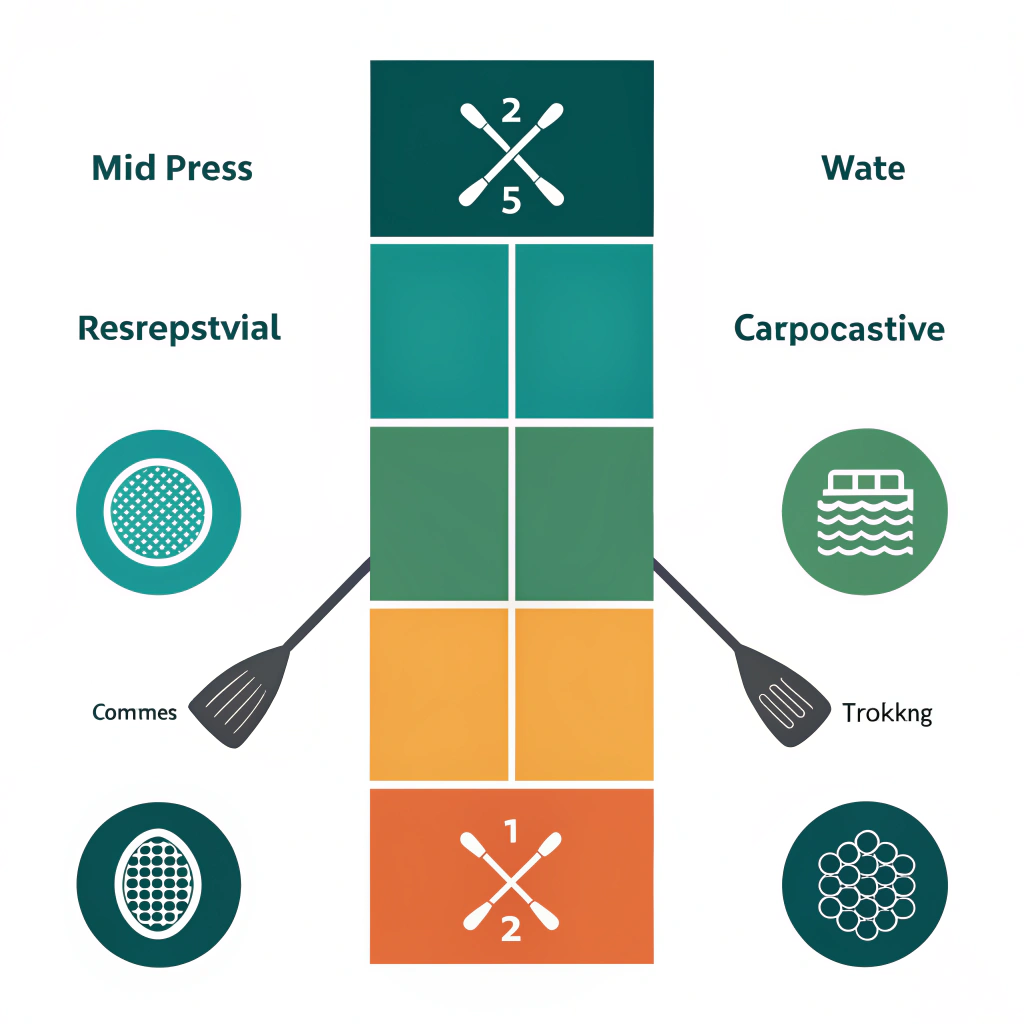
Solution checklist: matching construction to market segment
- Competitive / tournament paddles
- Face: 12K or T300 carbon fiber for hardness and consistent rebound.
- Core: polymer honeycomb or aluminum honeycomb, 14–16mm depending on desired power.
- Process: hot pressing for high consolidation and increased power.
- Goal: high pop, predictable stiffness, narrow weight tolerance.
- High-performance mid-range
- Face: 3K carbon fiber or carbon-fiberglass composite for balanced feel.
- Core: polymer honeycomb 14mm for balance of pop and control.
- Process: cold press or controlled hot press to preserve feel.
- Goal: mix of power and dwell time, broader sweet spot.
- Recreational / beginner
- Face: E‑Glass fiberglass for flexibility and larger sweet spot.
- Core: polymer honeycomb 13–16mm or bamboo composite for softer feel.
- Process: cold pressing or thermoforming to reduce cost and improve control.
- Goal: comfort, durability, and cost efficiency.
Material and process comparison table
| Aspect | 3K Carbon | 12K Carbon / T300 | E‑Glass Fiberglass | Polymer Honeycomb Core | Nomex Core | Aluminum Honeycomb |
|---|---|---|---|---|---|---|
| Stiffness | Medium | High | Low–Medium | Medium (varies by density) | High | High |
| Power / Pop | High | Very High | Medium | Medium–High | High | High |
| Dwell time / Control | Medium | Lower | Higher | Medium | Low | Medium |
| Durability | High | Very High | High | High | Very High | High |
| Cost (material) | Mid | High | Low–Mid | Low–Mid | Mid–High | High |
| Best for | Balanced high-level paddles | Tournament-grade paddles | Recreational / control paddles | General use, customizable | Extreme durability, niche | Premium power-oriented paddles |
Production process trade-offs
- Hot pressing
- Pros: better fiber consolidation, higher strength, often more power and consistent geometry.
- Cons: higher equipment and tooling cost; can reduce “plush” feel.
- Best when target is high-performance paddles with tight tolerances and high volume.
- Cold pressing
- Pros: preserves resin/fiber properties for more responsive feel, good control over thickness.
- Cons: longer cycle times and potential variability without strict process control.
- Best for mid‑range and control-focused paddles or lower temperature-sensitive materials.
- Thermoforming
- Pros: flexibility for complex shapes and targeted thickness distribution; good for custom designs.
- Cons: slow, higher tooling costs; suited to premium or small-batch runs.
- Best for premium custom SKUs and unique profiles.

Key spec decisions and their effects
- Core thickness (14mm vs 16mm): thicker cores (16mm) tend to increase power but reduce pop on short swings. For competitive players wanting drives and overheads, 16mm often increases ball speed on full swings; 14mm gives slightly more pop and control for dinks and punch volleys.
- Face weave: tighter weave (12K/T300) increases surface hardness and durability; 3K gives better flex and feel; E‑Glass increases dwell time and spin control due to higher elasticity.
- Weight and balance: lighter paddles (<7.8 oz) favor maneuverability; heavier paddles (>8.1 oz) increase power and stability. Specify weight bands per SKU to keep customer expectations consistent.
- Surface texture: micro‑texturing increases spin; perimeter edge foam or reinforced rails can widen effective sweet spot and stability.
Quality assurance metrics to require from OEM
- Dimensional tolerances: total length ±1 mm, width ±0.5 mm, thickness ±0.2 mm
- Weight tolerance: ±2–3% (recommend ±0.1–0.2 oz for premium lines)
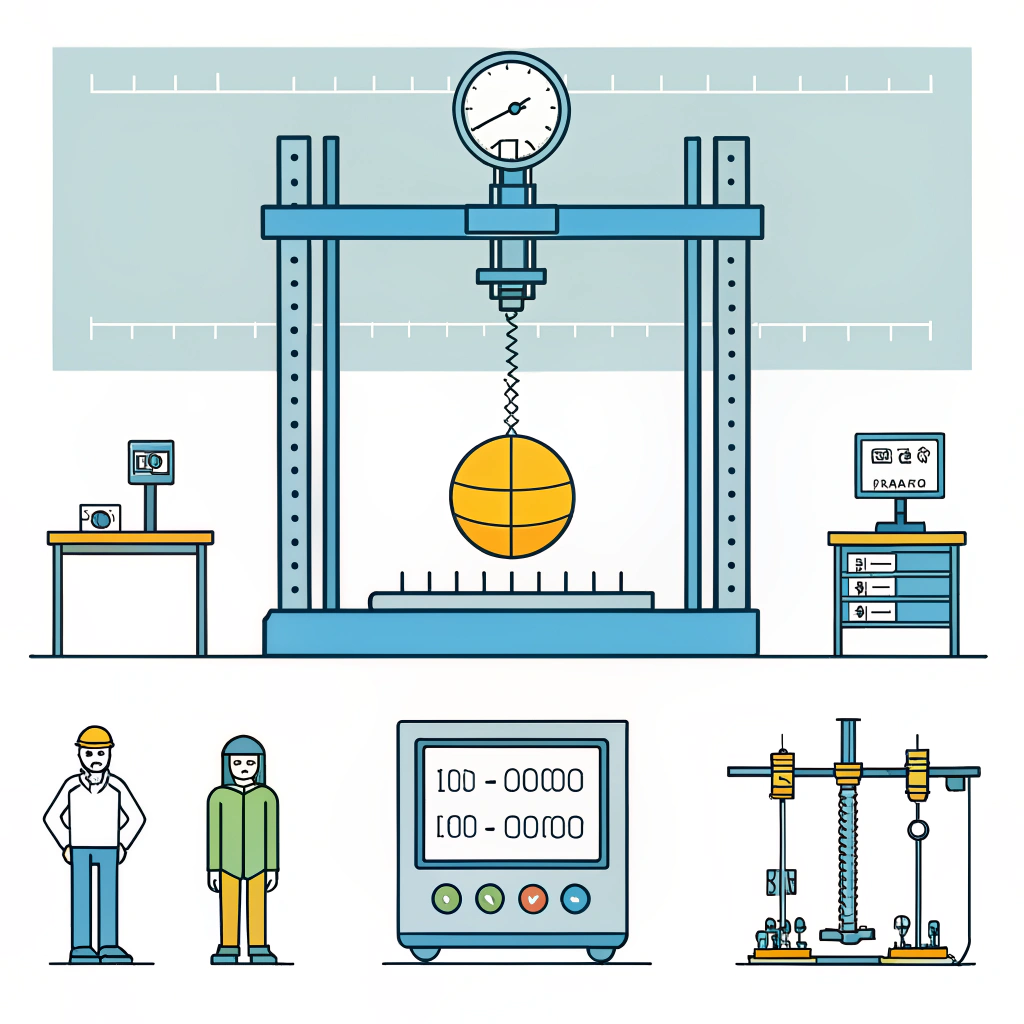
- Impact/durability: 5,000 cycles simulated ball impacts at service speeds without delamination
- Flex/deflection test: standardized deflection under a set load to compare stiffness across batches
- Surface adhesion / print durability: 1000 cycles abrasion test for printed graphics and coating
- Vibration measurement: accelerometer readings at handle to quantify damping (use as part of R&D)
- Failure analysis: provide detailed NCMR5 (nonconforming materials report) for defects >1%
Sample testing protocol (minimum)
- Batch sampling: 1% of production or min 10 paddles per SKU.
- Static measurements: weight, balance point, thickness mapping.
- Dynamic impact test: 1,000 hits at 40–50 mph equivalent to detect core-face separation.
- Environmental stability: 72 hours at 60°C + 90% RH for adhesion checks.
- Play test panel: 10 qualified players (assign metrics for pop, dwell, control).
- Publish batch report with pass/fail criteria.
Commercial constraints: MOQ, lead time, yield and cost
- MOQ: typical OEM ranges from 500–2,000 pcs per SKU depending on customization and printing. Full-color sublimation or on-demand print services may increase MOQ or per-unit cost.
- Lead time:
- Standard production (hot/cold press, tested): 45–70 days from PO, depending on capacity.
- Thermoforming/custom shapes: 70–120 days due to tooling.
- Rush options: possible at premium; expect higher scrap rates.
- Yield: expect initial yield losses during setup — typically 5–12% until process stabilized. Request trial runs with production samples to lock tolerances.
- Cost drivers: raw material (carbon vs fiberglass), core type (aluminum/nomex more expensive), process (hot press capital costs), print complexity, MOQ.
Recommended spec templates by target segment
- Competitive (Tournament)
- Face: T300 carbon, 2–3 plies; finish: micro‑textured
- Core: polymer honeycomb or aluminum, 14–16mm
- Weight: 7.6–8.1 oz ±0.1 oz
- Process: hot pressing
- QA: weight & deflection tolerance tight; 3,000+ impact cycles
- Performance consumer
- Face: 3K carbon or carbon-fiberglass composite
- Core: polymer honeycomb, 14mm
- Weight: 7.8–8.4 oz ±0.15 oz
- Process: controlled cold press
- QA: 1,000–2,000 impact cycles; cosmetic checks
- Recreational / retail
- Face: E‑Glass fiberglass
- Core: polymer honeycomb or bamboo composite, 13–16mm
- Weight: 8.0–8.6 oz ±0.2 oz
- Process: cold press or thermoforming (for cost-effective shapes)
- QA: visual + basic mechanical tests
Negotiation and onboarding tips
- Require initial pre-production samples and a small pilot run to verify yields and feel.
- Lock critical tolerances in the contract (weight bands, deflection range, visual standards).
- Specify remedy for out-of-spec batches (replacement, price adjustment).
- Ask for traceability: batch IDs for resin lot, core lot, and face material.
- Define warranty and conditions for returns related to manufacturing defects.
Case example (aggregate data)
- OEM A switched from E‑Glass + polymer core to 3K carbon + polymer core with cold pressing for a mid-range SKU. Result: perceived spin and control improved (player panel scoring +12%), production yield initially fell by 7% during process ramp, but final retail returns decreased by 18% due to better durability. Lead time increased by 10 days during the transition.
Summary + actionable procurement checklist
- Define player target and prioritize: power vs control vs cost.
- Choose face material by desired stiffness and durability: 12K/T300 for maximum power, 3K for balanced feel, E‑Glass for forgiving control.
- Select core material and thickness to tune power/pop: 16mm for power, 14mm for balance/pop.
- Specify manufacturing process based on performance and volume: hot pressing for performance/high volumes, cold pressing for feel, thermoforming for complex/custom shapes.
- Demand clear QA metrics, pilot runs, and contractual tolerances to control yield and warranty exposure.
If you want, provide your product lineup (target price points, target player levels, and annual volumes) and we can propose a tailored spec sheet and MOQ-optimized bill of materials to share with potential OEM partners.
People Also Ask
Does an expensive pickleball paddle make a difference?
Yes. Higher-priced paddles often use premium face materials such as raw carbon fiber (and sometimes Kevlar) and manufacturing methods that increase fiber consolidation (e.g., hot pressing). These choices produce a softer feel with more dwell time for control and spin, increased durability, and features like perimeter reinforcement that widen the effective sweet spot. The result is better control, spin potential, and stability—advantages competitive players value—though they come at higher material and production cost.
What has more power, a 14mm or 16mm pickleball paddle?
A 16mm core typically provides more overall power on full swings (drives, serves, overheads) because the thicker core can store and release more energy on long swings. Conversely, a 14mm core often yields higher “pop” on short swings (dinks, punch volleys) and can feel more responsive for touch shots. Choose 16mm for power-oriented competitive paddles and 14mm for players emphasizing quick touch and pop.
-
carbon fiber: Read the linked article to understand differences between fiber types (3K/12K/T300), trade-offs in tensile strength, weave tightness, and how face construction affects stiffness, durability, and cost — useful for selecting face layups by SKU. ↩ ↩
-
hot pressing: The linked resource describes hot-press process parameters, benefits for fiber consolidation and geometry control, tooling considerations, and when hot pressing justifies higher CAPEX and unit cost for consistent high-performance paddles. ↩ ↩
-
dwell time: Reading about dwell time explains how material and construction affect ball contact duration, spin generation, and perceived control — critical for specifying target player feel and designing play-test criteria. ↩ ↩
-
thermoforming: Learn how thermoforming enables complex shapes and localized thickness control, its tooling and cycle-time implications, and when it’s appropriate for premium or small-batch SKUs versus standard pressing methods. ↩ ↩
-
Nomex: The article explains Nomex honeycomb core characteristics (stiffness-to-weight, thermal resistance, bonding considerations), cost implications versus polymer or aluminum cores, and failure modes to watch in QA. ↩ ↩ ↩2