Skip to content

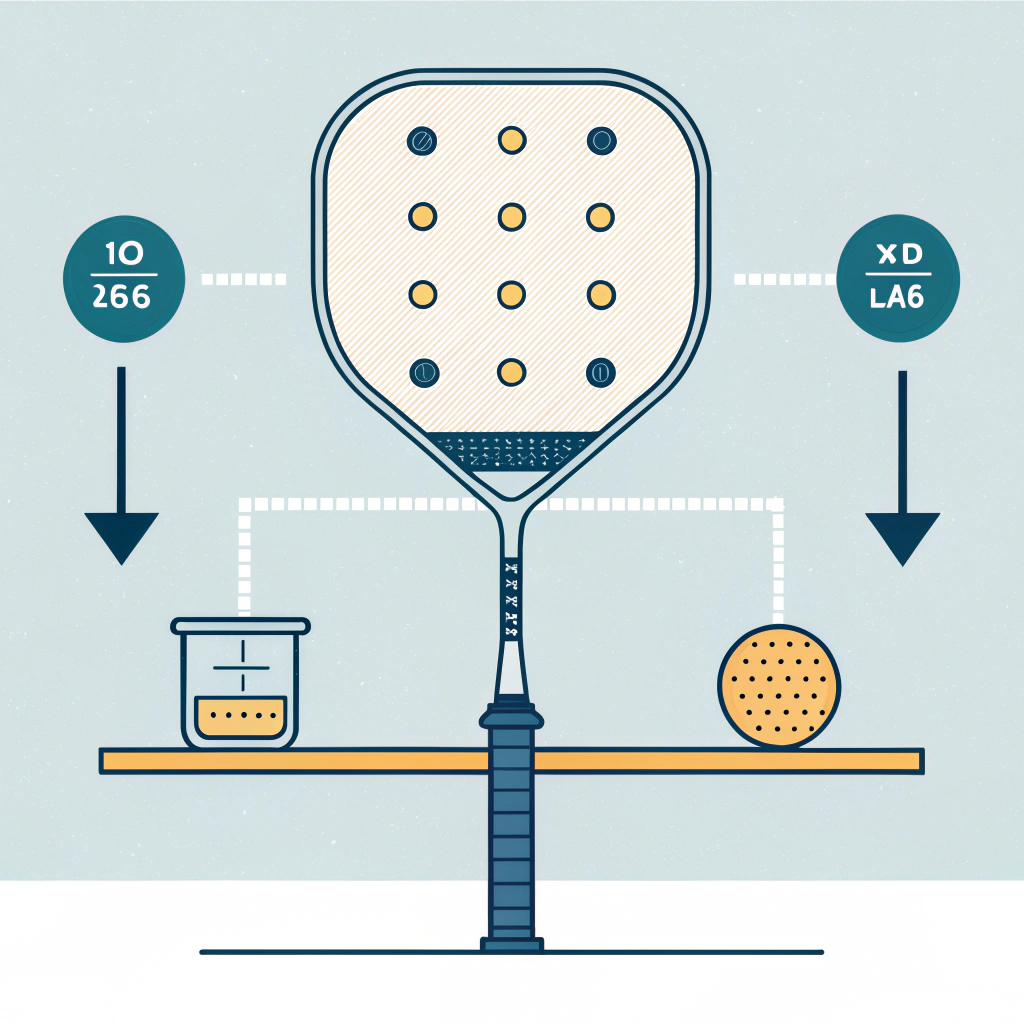
Quick answer (snippet-style): Weight distribution determines a paddle’s power, control, and stability. A paddle’s overall mass (grams), balance point1 (distance from the butt), and swing weight / moment of inertia (MOI)2 together set how the paddle feels in play: more mass toward the head raises MOI and power but reduces maneuverability; mass toward the handle improves speed and control. For OEMs3, target combination of total weight, balance point, and MOI — plus core and face materials and an appropriate production method — will reliably produce the intended player feel and repeatable SKU performance.
Why this matters to procurement and product managers
As you finalize prototypes and brief R&D, you’re balancing three buyer priorities: on-court performance (power vs control), manufacturability (process and material constraints), and cost/time-to-market. Weight distribution is the single most effective lever you can use to tune that trade-off. Getting it right in design and in production tolerances reduces expensive rework and returns, and speeds retail acceptance.

Core physics made practical
- Center of gravity (CG) / balance point: the static point along the paddle where it balances horizontally. Measured from the butt end (mm or inches). Moving CG toward the head makes the paddle feel “head-heavy.”
- Moment of inertia (MOI) / swing weight: a measure of how much torque is required to change the paddle’s angular velocity about the grip. Higher MOI = more stability on contact and greater power transfer, but slower snap at the wrist.
- Effective sweet spot: not just center of face stiffness, but also a function of MOI and face construction. Higher MOI often shifts the perceived sweet spot toward the head.
How these translate to player experience:
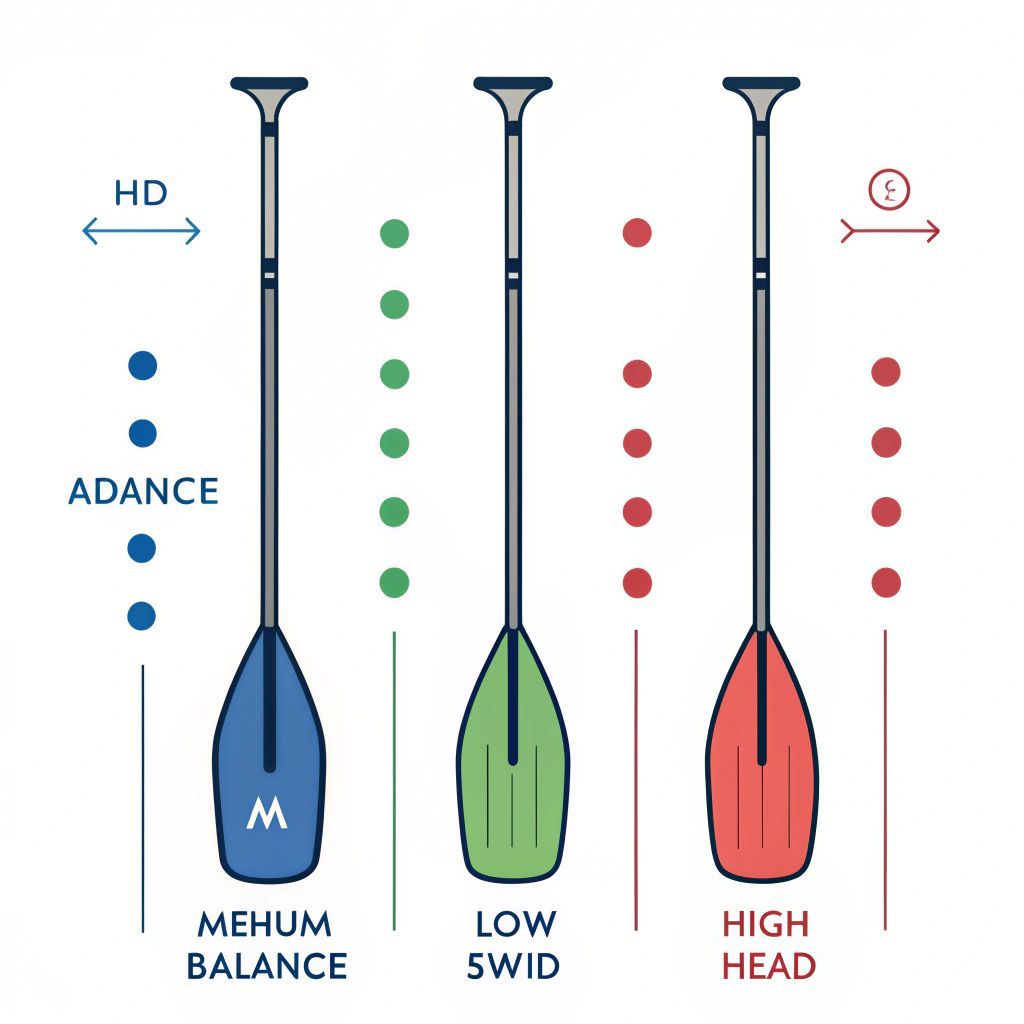
- Head-heavy (CG farther up): higher MOI → more power and stability on volleys and drives, less wristiness for quick reaction.
- Even balance: compromise between power and control, preferred by all-round players.
- Handle-heavy: lower MOI → faster maneuvering, quicker dinks and net play, but less plow-through on drives.
Quantified targets for procurement (actionable spec sheet)
Below are practical targets you can specify to R&D and suppliers. These are expressed as ranges — choose a narrow band for each SKU to maintain consistent feel.
- Total mass (tare weight): 210–260 g (typical commercial range)
- Recreational / entry: 200–220 g
- Club / advanced: 220–235 g
- Competitive / tournament: 235–255 g
- Balance point (from butt edge):
- Handle-heavy: < 5.2 in (13.2 cm)
- Even: 5.2 – 6.0 in (13.2 – 15.2 cm)
- Head-heavy: > 6.0 in (15.2 cm)
- Swing weight / MOI (relative bands — use lab calibration):
- Low MOI (fast): target 0–10% below model average
- Medium MOI (balanced): ±0–10% of model average
- High MOI (power/stability): 10–25% above model average
Recommended tolerances for OEM batches:
- Mass tolerance: ±3 g per paddle
- Balance point tolerance: ±0.2 cm
- MOI/swing-weight tolerance: ±5–8% (measured via the same method)
Why give ranges: these let production engineers choose core density and face layup to hit targets while keeping costs predictable.
Materials and process implications for hitting those specs
Table: Quick comparison of material/process vs influence on weight distribution and MOI
| Material / Process | Effect on Mass Distribution | Effect on MOI / Feel | Typical Cost / Notes |
|---|---|---|---|
| Carbon fiber face (3K/12K/T300) | Adds stiffness with minimal mass; face layup placement can shift head mass slightly | Increases rebound and stiffness; fine control over stiffness tuning | Premium; higher material cost; needs precise pressing |
| Fiberglass face (E-glass) | Slightly heavier for same stiffness; spreads mass more evenly | Softer feel, larger sweet spot, lower harsh feedback | Mid-cost; preferred for control models |
| Honeycomb polymer core | Lightweight; allows mass to be placed in perimeter/face | Lower vibration, controllable MOI via core thickness/density | Cost-effective; standard for many paddles |
| Nomex core | Denser than polymer; concentrates mass | Higher stiffness, higher MOI for same weight | More expensive; favored for durability |
| Hot pressing4 | Good bonding for multilayer faces; consistent thickness | Can slightly change material behavior (more rigid) | High throughput; higher equipment capex |
| Cold pressing | Preserves polymer and fiber properties; precise thickness control | Better ball feel and responsiveness | Lower throughput; more labor-sensitive |
| Thermoforming | Enables variable thickness and complex mass distribution | Best for custom balance tuning and stability | Slower; best for premium/custom SKUs |
How to translate:
- To raise MOI without changing total weight: concentrate mass toward perimeter/head — thicker face plies near edges, added internal weighting strips near the throat-to-face transition, or a denser core section toward the head.
- To lower MOI for maneuverability: shift material toward the handle — heavier grip, denser buttcap, thinner face ply toward the head, or hollow/low-density head sections.
- Use carbon fiber faces for competitive SKUs that need higher rebound and stiffness, and fiberglass for control-oriented SKUs with larger sweet spots.
Design levers (practical modifications)
- Face layup thickness and ply type — change stiffness and local mass.
- Core density and thickness — changes both total weight and stiffness; denser cores raise MOI more than lighter cores for the same shape.
- Butt/handle mass — adding mass in the handle reduces MOI and moves CG down.
- Edge and throat reinforcement — thin strips can significantly change MOI and stability.
- Internal weighting (discrete weights) — precise but adds complexity to manufacturing and QA.
Production tip: For a consistent SKU line, create a “mass distribution map” (CAD + BOM) showing grams allocated per region. Use a first-article report that lists measured mass, CG, and MOI.
Testing and QA — how to measure what matters
- Mass: digital scale (0.1 g resolution). Record each paddle.
- Balance point / CG: pivot jig (roller or knife-edge) with mm accuracy. Measure distance from butt edge and record.
- MOI / Swing weight: recommended methods:
- Rotary inertia machine (preferred) for direct MOI in standard units.
- Simple pendulum / swing-test bench for comparative evaluation among SKUs if rotary machine unavailable.
- Impact and durability: 5,000–10,000 ball impact cycles at specified energy to check delamination and core integrity.
- Flex and stiffness: three-point bend or localized deflection test to map face stiffness distribution.
- Visual/print QA: on-demand print registration, color consistency, and edge finish.
Sampling strategy for mass production:
- First article: 100% measurement (mass, CG, MOI).
- Pilot run: batch test 10% paddles.
- Mass production: statistical sampling per ISO 2859 or AQL5 levels; escalate to 100% if deviations exceed tolerances.

SKU recommendations (ready-to-brief templates)
- SKU A — Recreational / Retail Quick-Mover
- Weight: 205–215 g
- Balance: Even to slight handle-heavy (5.0–5.4 in)
- Face: Single-layer fiberglass (E-glass)
- Core: Polymer honeycomb (light)
- Process: Cold pressing
- Tolerances: ±3 g, balance ±0.25 cm
- Goal: Low price, easy playability, high durability
- SKU B — Club / All-round Favorite
- Weight: 220–230 g
- Balance: Even (5.4–6.0 in)
- Face: Carbon/fiberglass composite (2–3 plies carbon + FG)
- Core: Polymer or aluminum honeycomb
- Process: Hot pressing or thermoforming (for consistent layup)
- Tolerances: ±2.5 g, balance ±0.2 cm, MOI ±6%
- Goal: Balanced power/control, retail-ready aesthetic, on-demand print enabled
- SKU C — Competitive / Tournament
- Weight: 240–255 g
- Balance: Head-light to head-heavy depending on sub-model (6.0–6.6 in for power)
- Face: 12K or T300 carbon fiber
- Core: Nomex or high-density honeycomb for high stiffness
- Process: Hot pressing with tight lamination controls
- Tolerances: ±2 g, balance ±0.15 cm, MOI ±5%
- Goal: High rebound, high MOI, consistent pro-level performance
Procurement checklist before placing mass order
- Approve 3–5 first-article samples and lab reports for mass, CG, MOI, durability.
- Lock materials and layup CPK (capability index) — require supplier process control documents.
- Define weight and balance tolerances in PO and tooling specs.
- Agree testing protocol and sampling plan (AQL and escalation).
- Confirm lead times for different processes: hot pressing = higher throughput; cold/thermoforming = longer lead times for premium SKUs.
- Ensure artwork and on-demand print specs are finalized (bleeds, materials, oven/press compatibility).
Wrapping up — decision guidance
- If you need high throughput with consistent structural integrity and a slightly stiffer feel, prioritize hot pressing with well-defined layups and carbon faces for mid-to-high SKUs.
- If playability (feel and control) is the priority, specify cold pressing or thermoforming with fiberglass or carbon-fiberglass composites and tighter core control.
- Use the SKU templates above as starting points for prototyping. Lock tolerances and testing upfront — most quality and customer satisfaction issues stem from poor control on weight distribution and MOI rather than cosmetic defects.
People Also Ask
Q: How does weight affect a pickleball paddle?
A: Total weight influences power, swing speed, and player endurance. Heavier paddles let players put more force into the ball (more power and stability) but require more effort to swing and can reduce maneuverability. Lighter paddles increase wrist speed and control but may reduce drive power and block stability.
Q: Where to put weights on a pickleball paddle for more power?
A: To increase power, add mass toward the head and along the upper sides (or from the throat extending up the sides). This raises the MOI and improves stability on contact, producing higher ball speeds and better plow-through.
Q: Is a lighter or heavier pickleball paddle better?
A: Neither is universally better — it depends on playstyle and physical condition. Aggressive, power-oriented players often prefer heavier paddles for force and stability; players focused on finesse, quick volleys, or with joint concerns often choose lighter paddles for speed and comfort.
-
balance point: Read to get practical guidance on measuring and specifying the static center of gravity from the butt, how small shifts change perceived handling, and how to write tolerances into supplier specs to ensure SKU consistency. ↩
-
swing weight / moment of inertia (MOI): Read to understand how MOI is defined and measured, why it controls power vs. maneuverability, which lab methods produce repeatable numbers, and how to set percentage bands for SKU differentiation. ↩
-
OEMs: Read to learn the manufacturer-side considerations (process selection, tooling, first-article requirements, and supplier QA) that procurement teams must control to deliver repeatable player feel at scale. ↩
-
Hot pressing: Read to understand the hot-press lamination process, its effects on bonding and stiffness, equipment and capex implications, and when it’s the right choice vs. cold pressing or thermoforming for different SKU tiers. ↩
-
AQL: Read to learn how Acceptable Quality Limit sampling works, how to set AQL/ISO 2859 plans in purchase orders, and when to escalate to 100% inspection to protect your brand and reduce returns. ↩