Skip to content

A quick answer: For clubs and retailers sourcing for beginners, choose a wide-body, lightweight paddle with a polymer honeycomb core1, a fiberglass or composite face, a grip size around 4 to 4-1/4 inches, and a retail price target in the $25–$75 range. Prioritize durability, predictable feel, and low warranty/return risk from the supplier. Below is a practical, side‑by‑side guide to help you shortlist models and evaluate manufacturers for a beginner paddle program.
You need paddles that are:
- Easy for new players to use (forgiving sweet spot and low vibration)
- Durable under heavy use (less downtime, fewer replacements)
- Low enough cost to hit your margin or program budget
- Customizable for branding or retail private label
- From a supplier who can meet MOQ2, sample, and lead‑time needs
This guide breaks down the important specs, explains tradeoffs, gives supplier/production notes, and ends with a procurement checklist you can use to pick 2–3 paddles to trial.
- Shape: Wide-body (wider sweet spot, easier contact)
- Weight: 7.2–8.0 oz (lightweight for juniors and most beginners)
- Core: Polymer honeycomb core (best balance of feel, vibration control, durability for beginners)
- Face: Fiberglass or Carbon-Fiberglass composite (fiberglass gives more control; composites add durability)
- Grip size: 4.0–4.25 inches (most adult beginners)
- Price band (FOB factory3): $6–$18 each; retail pricing strategy: $25–$75 depending on margin & retail channel
- MOQ: Typical OEM MOQs: 500–1,000 units per model; sample lead time: 7–21 days; bulk lead time: 30–75 days depending on complexity
New players need forgiveness and comfort. Core material determines feel, control and durability.
- Polymer honeycomb core: Softer, more elastic, reduces vibration, and gives a comfortable hitting feel. It absorbs shock better, making it easier for beginners to control volleys and returns. It tends to be more cost-effective and durable in daily club use.
- Nomex honeycomb core: Very hard, high rebound—better for advanced players seeking power. Not ideal for beginners because it increases bounce and vibration.
- Aluminum honeycomb core: Midway between Nomex and polymer. Offers power and some control, but can be noisier and less comfortable for new players.
First occurrence highlights: polymer honeycomb core (bolded earlier).
Your choice of face affects spin, control, durability and cost.
- Fiberglass (E‑Glass): Softer feel, larger sweet spot perception, excellent ball control. Lower cost than carbon. Often the best balance for beginner paddles that must be forgiving.
- Carbon fiber: Stiffer, more responsive, and offers higher power and spin potential. Generally more expensive. For beginners, pure carbon can be overkill and reduce forgiveness.
- Carbon + Fiberglass composite: Blends the control of fiberglass with the stiffness of carbon. Good option when you want some performance cachet without the full cost of carbon.
Include this table for quick comparison:
| Feature / Material | Fiberglass | Carbon Fiber | Carbon+Fiberglass Composite |
|---|---|---|---|
| Feel (soft → stiff) | Soft | Stiff | Medium |
| Forgiveness for beginners | High | Low-Medium | Medium-High |
| Durability (club use) | Good | Very Good | Very Good |
| Cost (factory) | Low-Mid | High | Mid-High |
| Recommended for | Best beginner / recreational | Advanced / competitive | Premium beginner / retail |
- Lightweight (7.2–7.8 oz): Easier swing, better for quick reactions and juniors. Slightly less drive power but higher control.
- Midweight (7.8–8.4 oz): Better balance between power and control—suitable if your buyer demographic includes taller adults or heavier hitters.
- Balance: Head‑light or neutral balance improves maneuverability at the net. Avoid heavy head‑weighted paddles for beginner libraries.
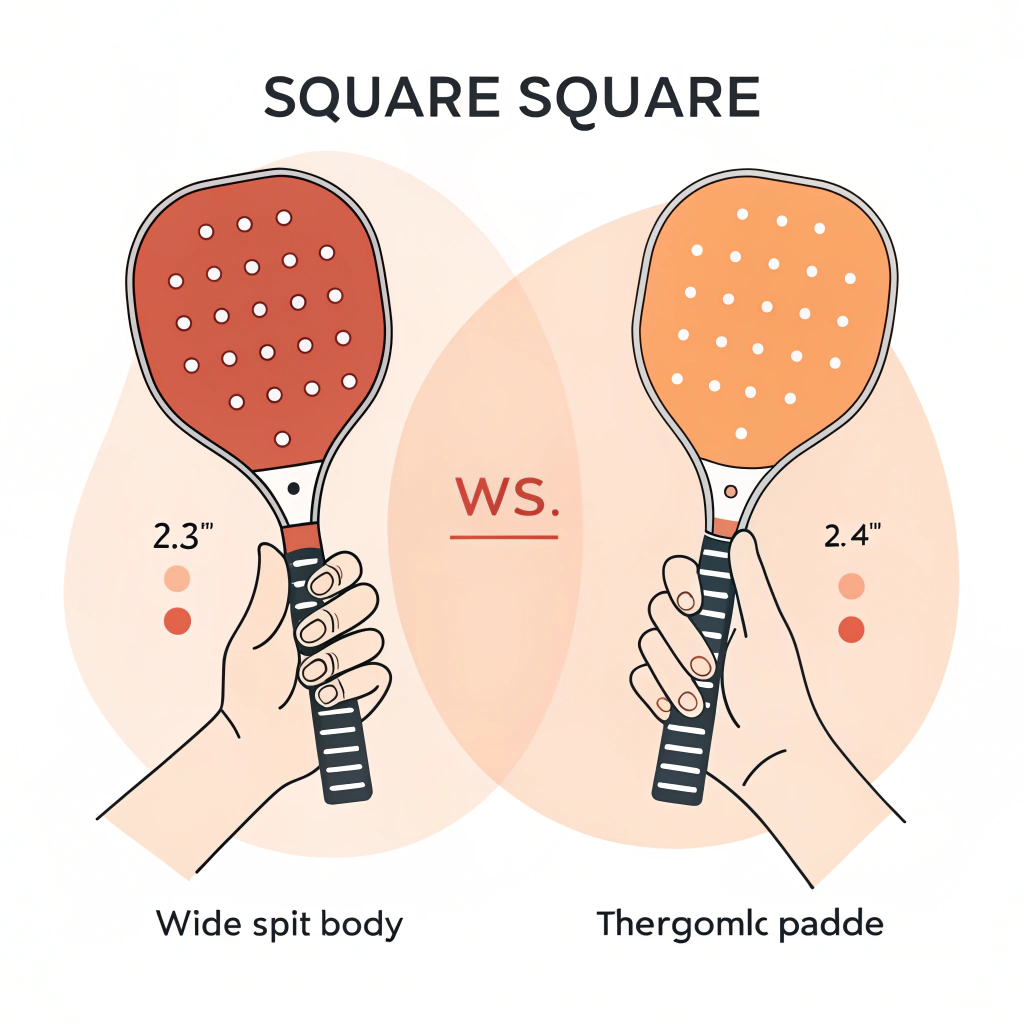
Grip size matters for comfort and injury prevention. For beginners, recommend a grip circumference of 4.0–4.25 inches. Provide at least one paddle with a wrap or tacky surface. Offer two grip options if possible (standard and slim) when ordering larger lots.
When evaluating samples, measure:
- Surface wear after 1,000 ball strikes (machine or manual)—no delamination or cracking
- Edge guard durability after drop/impact tests
- Core integrity after temperature cycling (simulate outdoor storage)
- Vibration/comfort: subjective test panels with novices for feedback
- Warranty claims rate: ask supplier historical returns for similar models
For beginner program use, a durable paddle should show minimal structural degradation after heavy weekly use (e.g., 10–20 hits/day for 6 months).
When qualifying an OEM pickleball manufacturer4 or private label partner, collect these specifics:
- Production processes used (hot pressing vs cold pressing5 vs thermoforming) and which process is used for the sample model. Cold pressing preserves material feel; hot pressing is faster for large runs.
- Core type and face material specifications (e.g., 2.0 mm polymer core, E‑Glass face)
- Minimum Order Quantity (MOQ) per SKU and color/print: typical ranges 500–1,000
- Sample policy: sample price, sample lead time (7–21 days), are samples serialized?
- Lead time for bulk orders: typical 30–75 days after pre-production sample approval
- Printing options: full wrap vs spot print, Pantone or CMYK match, on‑demand printing availability
- Quality control: what tests are run, defect rate, third-party testing (if any)
- Packaging: bulk vs retail-ready boxes, UPC/labels, instructions included
- Intellectual property and artwork protection: tooling, mold ownership, NDA
NEX Pickleball capabilities note: we support hot pressing, cold pressing, and thermoforming, various core materials including polymer honeycomb, Nomex and aluminum, and offer private label / on‑demand print services. This range lets you balance price and performance.
- Shortlist 3 models by material/price:
- Model A (budget): Fiberglass face + polymer core; 7.4 oz; target FOB $6–8
- Model B (value): Composite face + polymer core; 7.8 oz; target FOB $9–12
- Model C (premium beginner): Composite face + polymer core + enhanced grip; 8.0 oz; target FOB $13–18
- Order samples: 3–6 units of each model (mix of right/left handers if needed)
- Run a 4‑week user trial with 10–15 new players; record durability and perceived control
- Check packaging and branding proofs; confirm print color match
- Decide which 1–2 SKUs to place an initial bulk order (MOQ) for pilot program

- If factory FOB is $8, landed cost (freight, duty, inspection) may be $10–12.
- Retail price target $25–45 gives room for distribution and margin for clubs or retailers.
- For program rentals (clubs), you may want to keep replacement cost per paddle under $30.
- Material & core specified (polymer core recommended)
- Shape: wide-body confirmed
- Weight & grip size specified
- Sample lead time and price clarified
- MOQ per SKU and color confirmed
- Production process for that model documented (cold vs hot pressed)
- Printing method & artwork proofing steps agreed
- QC tests and acceptable defect rate written into the contract
- Shipping lead time and incoterms (FOB/CIF) confirmed
- Warranty & sample / first-batch inspection terms agreed
For beginner paddles intended for retail or club programs, the best starting point is a wide-body, polymer-core paddle with a fiberglass or composite face, weighing 7.2–8.0 oz, and a grip around 4.0–4.25 inches. Order samples from 2–3 models, run a short trial with novice players focused on feel and durability, and confirm MOQ, printing, and lead time with your OEM. If you need a supplier who can produce across hot-press, cold-press and thermoforming processes and handle private‑label printing, prioritize vendors like NEX Pickleball that list these capabilities and provide clear sample and QC protocols.
People Also Ask
-
What is the best pickleball paddle shape for beginners?
Wide‑body paddles are generally best for beginners because they provide a larger sweet spot, more forgiveness on off-center hits, and easier ball contact. This shape reduces mishits and helps new players build consistency faster. -
How much should a beginner spend on a pickleball paddle?
Beginner paddles commonly retail from about $25 to $75. Factory or FOB costs for entry-level models are often in the $6–$18 range depending on materials and customization. Choose a paddle in the lower‑to‑mid price band that balances durability and feel, rather than the most expensive performance models.
-
polymer honeycomb core: Read this to understand the material properties, how polymer cores affect vibration, feel and durability, and why they’re often the best balance for club/retail beginner programs. ↩ ↩
-
MOQ: Read this to learn how Minimum Order Quantities affect unit pricing, inventory strategy, negotiating levers with manufacturers, and how to plan pilot orders to minimize risk. ↩ ↩
-
FOB factory: Read this to understand the FOB Incoterm—what costs are included/excluded at the factory point, and how to calculate landed cost and margins for retail and club programs. ↩ ↩
-
OEM pickleball manufacturer: Read this to clarify OEM vs ODM/private label, what supplier capabilities and certifications to verify, and how to vet manufacturing partners for quality, IP protection, and supply reliability. ↩ ↩
-
cold pressing: Read this to compare production processes (cold press vs hot press vs thermoforming), their impact on paddle feel, cycle time, tooling costs, and quality consistency for small vs large runs. ↩ ↩