Skip to content


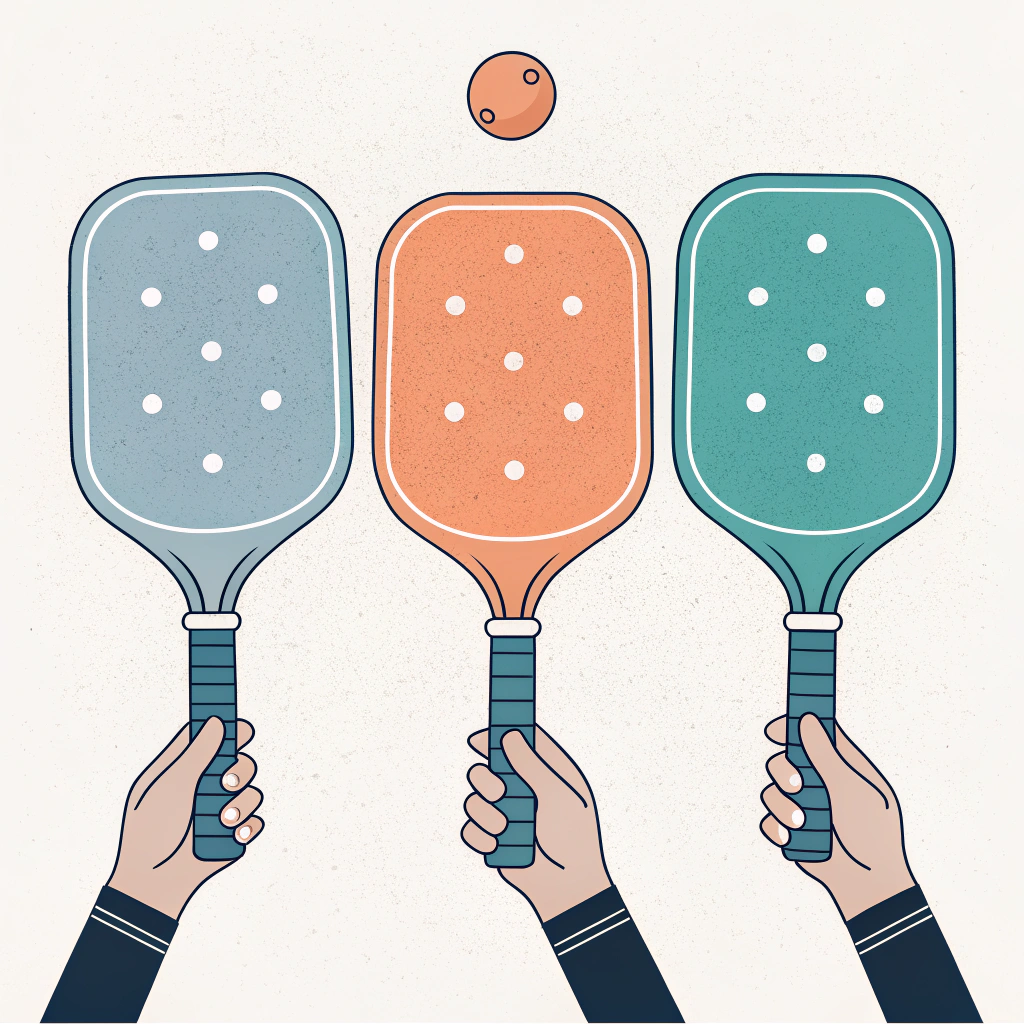
Quick answer: For B2B paddle specs, offer a three-SKU1 handle-length line—Short (~4.0") for control and small hands, Standard (4.5"–5.0") for most players, and Long (5.25"–5.5"+) for reach/two-handed options—while balancing weight, balance point, and manufacturing tolerances (hot press, cold press, thermoforming2) to meet performance and margin goals.
Why handle length matters for procurement and product design
- Handle length directly changes ergonomics, leverage and the way players generate power and spin.
- For procurement and product managers, handle length is a high-impact spec: it affects SKU complexity, tooling, assembly, packaging, and return rates.
- Decisions must weigh player needs (single-hand vs two-hand), grip size, moment of inertia3, and manufacturing capabilities.
Core trade-offs you need to evaluate
- Control vs. Maneuverability: Shorter handles shorten the lever arm, improving wrist control and quick reaction at the net. Longer handles increase reach but typically increase perceived swing weight and reduce quick maneuverability.
- Power vs. Precision: Longer handles enable two-handed strokes that deliver more torque and reach; shorter handles favor wrist snap and fine control.
- Hand size and grip circumference: A longer handle is often required for larger hands or for players using two hands. Incorrect grip fit increases slips and reduces player comfort.
- Manufacturing and cost: More handle-length SKUs increase tooling, inventory and assembly complexity. Certain forming processes have limits on how thin or long a handle profile can be produced repeatably.
Technical effects explained simply
- Moment of inertia (I): Simplified, I ≈ Σ(mass × distance^2). If a paddle’s handle length changes the player’s grip position relative to the head, the effective lever arm for head mass changes, altering swing feel. Longer effective lever arms can increase torque for power but make rapid directional changes harder.
- Balance point: Moving the grip or changing handle length shifts the paddle’s balance point. Two paddles of identical total mass but different handle lengths will feel different—balance point and swing weight matter as much as gross mass.
- Two-handed play: A longer handle allows the top hand to sit higher, improving leverage for two-handed backhands and volleys. It changes hand spacing and wrist mechanics—often converting smaller rotational movements into greater racket-head speed.
Recommended handle-length SKU strategy (practical for OEM/brands)
Offer three primary lengths to cover most customers while minimizing SKU complexity:
- Short (Control): 4.0" ±0.05" — for control-minded players, smaller hands, and junior/compact models.
- Standard (All-round): 4.5"–5.0" — default for general retail and OEM lines.
- Long (Power/Two-handed): 5.25"–5.5"+ — for competitive/elongated models and players who need reach or two-handed strokes.
Table — Example SKU configuration and target buyer
| SKU name | Handle length (butt to throat) | Target user | Typical grip circumference | Typical balance effect |
|---|---|---|---|---|
| Short / Control | 4.0" (102 mm) | Singles/net players, small hands | 4.0"–4.25" (circumference) | Head-light / quick feel |
| Standard / All-round | 4.5"–5.0" (114–127 mm) | Most recreational & retail | 4.25"–4.5" | Neutral balance |
| Long / Power | 5.25"–5.5"+ (133–140+ mm) | Two-handed/competitive players | 4.5"+ | Slight head-heavy feel, more reach |
Notes:
- Measure handle length from the butt cap to the throat junction. Specify units in the spec sheet (mm and inches).
- Include grip circumference (wrap diameter) and recommended overgrip combinations.
Manufacturing constraints and tolerances (what to ask your supplier)
- Hot pressing: Good for high-volume, dense builds. Typical repeatability: ±0.3–0.8 mm in handle length and shape, depending on tooling and post-trim controls. Best for rigid core + carbon fiber faces.
- Cold pressing: Better retention of raw material feel; ±0.1–0.4 mm achievable with stable tooling. Recommended when precise handle thickness, taper and feel are critical.
- Thermoforming: Good for complex handle contours and custom shapes. Typical tolerance ±0.5–1.0 mm; tighter tolerances raise cycle time and cost.
- End-cap and butt tooling: End-cap thickness and attachment method can add ±0.5–1.5 mm effective handle length unless trimmed to spec — specify whether handle length is measured before or after end-cap install.
Manufacturing checklist for procurement/specs:
- Define handle-length measurement point (butt cap to throat).
- Specify post-end-cap install length tolerance.
- Provide desired grip circumference and grip taper profile (e.g., conical, straight).
- State production process per SKU (hot press / cold press / thermoforming).
- Ask for sample verification: 1st-article inspection with CMM or calibrated calipers and swing-weight confirmation.
- Production batch QC: sample size, frequency, allowable deviation.
Testing and validation you can require
- Static measurement: Use calipers or CMM to confirm handle length tolerance on first articles.
- Swingweight4 (rotational inertia): Use a pendulum swing or dedicated swing weight meter. Provide target swing-weight ranges for each SKU (e.g., 85–95 g·cm^2 for quick models, 110–130 g·cm^2 for power models) — set these as acceptance criteria.
- Player testing: At least 5–10 playtest sessions with specified player archetypes (small-hand, medium-hand, two-handed backhand) and structured feedback forms.
- Balance point: Measure from butt to center of mass; record and compare against spec.
- Durability: torque tests on handle/head joint, repeated impact at throat and head.
Sample spec sheet snippet (copy into your RFP)
- Model name:
- Handle length (butt to throat): 4.50" ±0.15" (114.3 mm ±3.8 mm)
- Grip circumference (pre-wrap): 4.25" (108 mm)
- Handle taper profile: conical 8° taper from butt to throat
- Handle material: molded polymer over foam core or wrapped wood/ABS core (specify)
- End-cap: integrated / removable, material, finish
- Balance point target: 8.5" from butt (±0.2")
- Swing weight target: 95 ±5 g·cm^2
- Production process: Cold press; sample approval required
- QC: 5% sample check per batch; F.A.I. report required
Cost and SKU complexity considerations
- Each additional handle-length SKU increases tooling and assembly complexity and may raise MOQ5. Aim to keep to 2–4 handle-lengths for a typical production family.
- Consider modularity: same head shape and face material with different handle subassemblies (butt + grip) to limit full-paddle tooling changes.
- On-demand printing and branding can share head inventory across handle variants to reduce costs.
Ergonomic details procurement teams should be specific about
- Grip size vs handle length: larger handle lengths often pair with larger circumference. Specify allowed grip wrap thickness to maintain target circumference.
- Handle taper and texture: Taper affects hand placement and comfort; define radius and material hardness.
- End-cap geometry: influences where the hand seats and whether a player can choke up for volleys.
Decision flow for selecting handle-length SKUs
- Define target customer segments (recreational, advanced, two-handed players).
- Choose a primary and secondary SKU (Standard + either Short or Long).
- Validate with prototyping: sample sets for each handle length using final production process.
- Confirm tolerances, swing-weight and balance with measurement and playtest.
- Lock tooling and MOQ; set reorder cadence.
Operational tips for procurement negotiation
- Ask suppliers for first-piece measurement reports and swing-weight data with every batch for the first three production runs.
- Negotiate a small-charge for additional handle-length tooling if you commit to minimum volume across the family.
- Consider combining handle variations via interchangeable butt caps or screw-in extensions for premium/custom lines.

Summary and recommended next steps
- Offer a three-tier handle-length lineup (Short, Standard, Long) as a practical B2B SKU strategy that covers most player needs while limiting complexity.
- Specify clear measurement points and tolerances in the RFP, and require swing-weight and balance confirmation.
- Choose production process per SKU: cold press for tight tolerances/feel, hot press for volume and durability, thermoforming for complex contours.
- Run both lab (swing-weight, balance) and user (playtest) validations before mass production.
- Ask your supplier for first-article reports and target QC frequency to avoid customer complaints and returns.
People Also Ask
Q: Is a short or long handle pickleball paddle better?
A: Neither is universally better—short handles favor control, wrist maneuverability and smaller hands; long handles add reach and make it easier to use two-handed strokes and generate power. Choose based on player target (control vs. power), hand size, and the intended use of the paddle (net play, baseline, or two-handed backhand).
Q: How long should your pickleball handle be?
A: Measure from the butt cap to the throat and match length to the player group: under 4.25" tends to suit very small hands or junior models; 4.5"–5.0" is the standard retail range for most adult players; 5.25"–5.5"+ is for players needing reach or two-handed play. Also specify grip circumference and overwrap to control final fit.
Q: What does a longer pickleball paddle do?
A: A longer paddle increases reach and can raise the sweet spot slightly, enabling more torque and power—especially on two-handed strokes—but it can take time for players to adapt because it changes balance and swing feel. For brands, longer paddles are best positioned as competitive or specialty SKUs.
-
three-SKU: Read this to understand SKU definition and best practices for SKU rationalization—how limiting handle-length SKUs reduces tooling, inventory and assembly costs while still covering key customer segments (useful for procurement and product strategy). ↩
-
thermoforming: Read this to see how thermoforming works versus hot/cold pressing, its tolerance and cost trade-offs, and when it's the right choice for complex handle contours or custom ergonomic profiles. ↩
-
moment of inertia: Reading this explains how leverage and mass distribution affect perceived swing feel and torque, and why small changes in handle length or balance point can change player performance—critical when setting swing-weight and balance specs. ↩
-
Swingweight: Read this to learn how swing weight (rotational inertia) is measured, how it relates to player feel and performance, and practical target ranges to use as acceptance criteria in RFPs and QC. ↩
-
MOQ: Read this to learn how minimum order quantities affect per-unit cost, tooling amortization and negotiation levers with suppliers when adding handle-length SKUs. ↩