Skip to content

Quick answer — Choose a paddle handle length by matching target player profiles and play styles to measurable spec ranges: for most retail SKUs use a standard handle (~4.75–5.25 in / 12.1–13.3 cm); offer short handles (~4.25–4.75 in / 10.8–12.1 cm) for players prioritizing wrist control and maneuverability; and offer long handles (~5.25–6.5 in / 13.3–16.5 cm) when reach/leverage or two‑handed play is required. Manufacturing method (hot pressing, cold pressing, thermoforming1), core type and balance requirements will affect tooling, MOQ2 and weight distribution — plan samples and testing (swing weight3, balance point4, durability) before final OEM sign-off.
Why handle length matters for procurement
- Handle length changes how a paddle is held, swung and balanced. That affects player comfort, control, and the paddle’s effective sweet spot.
- Procurement decisions must balance player segmentation (recreational vs competitive, one‑hand vs two‑hand backhand, age/hand size), production constraints (tooling, press method, mold complexity), and commercial constraints (SKU count, MOQ, unit cost, shipping cubic meters).
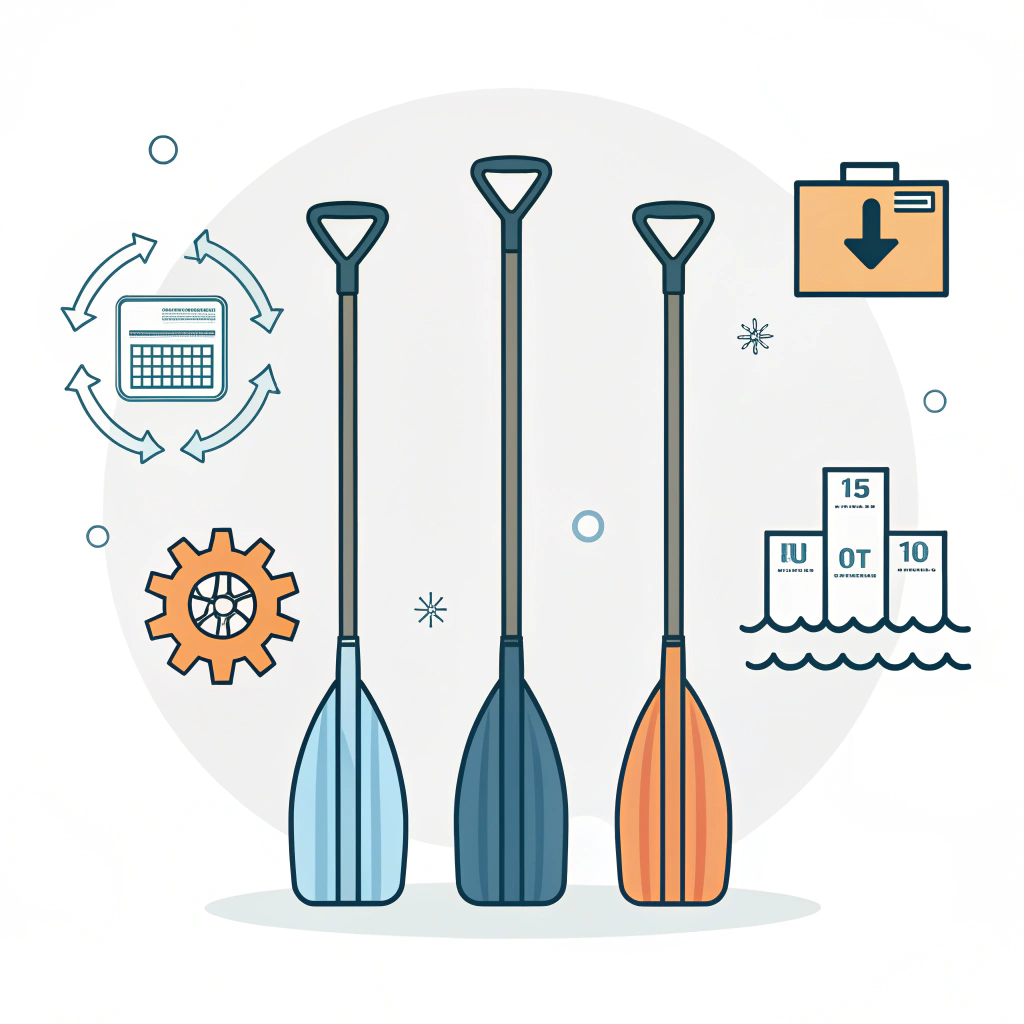
Comparison overview: short, standard and long handle paddles
Use this quick comparison to align product strategy with target customers and manufacturing realities.
| Dimension | Short handle | Standard handle | Long handle |
|---|---|---|---|
| Recommended grip length (approx) | 4.25–4.75 in (10.8–12.1 cm) | 4.75–5.25 in (12.1–13.3 cm) | 5.25–6.5 in (13.3–16.5 cm) |
| Primary benefit | Quick wrist, better maneuvering, faster block & dinking | Balanced control/power for mainstream players | Extra reach & leverage, easier two‑handed backhand |
| Best for | Smaller hands, junior/female players, quick net play | Broad retail audience | Taller players, two‑hand backhand users, power players |
| Sweet spot effect | Slightly lower/closer to handle — better control | Centered | Can raise sweet spot and change effective hitting area |
| Impact on balance | Shorter handle → head‑heavier feeling | Neutral | Longer handle → more head‑light or requires added head weight |
| Manufacturing ease | Easiest for existing molds | Standard tooling | May need new mold length / inserts |
| Cost & MOQ impact | Minimal | Minimal | Higher tooling cost & potential higher MOQ |
| Logistics | Lower package length | Standard | Increased packaging cubic volume |
Note: these ranges reflect the handle length measured from the top of the butt cap to where the handle meets the paddle face. Confirm exact measurement convention with supplier.
Player segmentation: who needs what (practical guidance)
- Recreational players and general retail: Default to standard handle (4.75–5.25 in). It fits most hand sizes and minimizes SKU complexity.
- Junior and small‑hand buyers: Offer short handle option. Short handles suit players prioritizing wrist feel and court maneuverability.
- Competitive/power players and two‑hand backhand users: Offer long handle or elongated overall paddle geometry. Long handles help reach and create additional leverage for drives and serves.
- Clubs and rental programs: Prefer standard handles for interchangeability and lower replacement inventory complexity.

Detailed technical trade-offs and manufacturing implications
-
Balance and mass distribution
- Extending the handle shifts the center of mass toward the grip unless compensated with additional head weight. That alters swing weight (moment of inertia), which affects power and control.
- Procurement teams should specify both nominal mass (grams/oz) and balance point (cm from butt cap) for each handle-length variant.
-
Tooling and mold complexity
- Thermoforming enables complex ergonomic handle shapes and integrated flares, but increases cycle time and tooling cost.
- Hot pressing is ideal for high-volume runs but may require different press dies or longer press plates for extended handles.
- Cold pressing offers precision on thickness and feel; it’s preferred when consistent grip geometry is critical but it can slow throughput.
-
Core & face interaction
- Handle length affects how the paddle flexes under load. For honeycomb cores5 (polymer, aluminum, Nomex) specify stiffness targets that keep feel consistent across handle lengths.
- If using carbon fiber faces (3K, 12K, T300) or fiberglass, ensure the face layup and handle interface maintain torsional rigidity when handle length changes.
-
Cost and MOQ considerations
- Standard handle lengths typically fall into standard SKU tooling—lower per‑unit cost and standard MOQ (commonly 500–2,000 per SKU depending on supplier).
- Custom/extended handle molds or thermoformed handles may raise MOQ (typical OEM ranges: 1,000–3,000 per custom mold) and tooling amortization.
- Discuss staggered MOQ strategies: launch standard handle SKUs first, validate sales, then add short/long variants as demand justifies tooling amortization.
-
Lead times (typical benchmarks)
- Prototype/sample: 2–4 weeks for a single sample (depends on printing/finishing).
- Small production run (pre‑production): 4–6 weeks after sample approval.
- Mass production: 45–75 days depending on process (hot press faster at scale; thermoforming/cold press can add time).
- Always confirm calendar lead times and whether production windows overlap with other lines to avoid tooling bottlenecks.
Practical spec recommendations for OEM paddle specs
Include these fields when requesting quotes or signing a PO. Being precise reduces iterations and sample cycles.
Recommended spec template (minimum fields)
- SKU / model name
- Target player segment (e.g., recreational adult female, competitive male—height range)
- Handle length (inches / cm) — e.g., 4.75 in / 12.1 cm
- Grip circumference & wrap (e.g., 4 1/4" circumference; cushioned PU wrap)
- Paddle face material & layup (e.g., T300 carbon fiber 2×2 twill)
- Core type & density (e.g., polymer honeycomb, 6 mm)
- Target mass (± 3 g)
- Balance point from butt cap (cm)
- Swing weight target (if measured) / or describe feel goal (e.g., quick maneuver)
- Edge guard or full‑frame construction
- Surface finish & print (on‑demand print options)
- Packaging dimensions & desired box style
- MOQ & target price (FOB)
- Sample approval protocol & testing checklist
Testing checklist before sign‑off (sample stage)
- Mass consistency: measure ± tolerance across 10 samples.
- Balance point: record cm from butt cap; compare to spec.
- Swing weight / moment of inertia: measure with consistent method.
- Durability tests: repeated ball‑strike cycle, edge impact tests, stress at handle joint.
- Grip ergonomics: circumference, taper, feel across sizes; two‑hand backhand user test.
- Play testing across target player set: dinking, volleying, third‑shot drives, serve returns.
- Environmental testing: heat/UV exposure to print and adhesives if relevant.
- Drop & transport simulation: confirm packaging protects longer handles.
Packaging & logistics — details procurement must check
- Packaging length: a longer handle increases box length. Confirm folded or detached handle is not permitted — most paddles ship assembled.
- Cubic volume: ask suppliers for both unit carton and master carton dimensions. Longer SKUs can increase freight by 5–15% per pallet depending on orientation.
- Palletization: longer boxes may reduce quantity per pallet; recalculate landed cost and MOQ impact.
- Labelling and barcodes: include SKU variants for handle length to ease returns and replacements.
Decision flow for procurement (simple 6‑step)
- Confirm target players and % split (e.g., 70% recreational standard, 20% small‑hands, 10% competitive).
- Choose primary handle length for SKU family (start with standard).
- Request samples in short/standard/long from shortlisted OEMs using unified test protocol.
- Compare swing weight, balance point and play feedback; check manufacturing constraints (tooling, lead time).
- Review MOQ and cost delta for additional handle variants — model projected sales to see if extra SKU justified.
- Finalize specification sheet and sign tooling/incoterms, retaining rights for design and print files.
Case example (decision applied)
- Brand A: mass‑market line targeted at clubs and retailers (balanced players). Decision: single standard handle SKU to limit SKU count, additional short handle made available as special order (MOQ 1k).
- Brand B: niche competitive line for taller players and clubs offering advanced clinics. Decision: two SKUs — standard + long handle; thermoforming used to add ergonomic longer grip; tooling cost approved and amortized over higher price point.
Summary + procurement action checklist
- Default to a standard handle for wide retail adoption; offer short and long handles only when target demographics justify extra tooling and logistics complexity.
- Always specify both length and balance point; require supplier to confirm center of mass and swing weight.
- Include a rigorous sample testing protocol covering mass, balance, swing weight, durability and player feedback.
- Account for manufacturing method impacts: hot pressing for volume, cold pressing for feel precision, thermoforming for complex handles — each has different cost, lead time and MOQ implications.
- Prepare packaging and logistics calculations for longer handles to avoid unexpected freight costs.
Next steps for procurement teams:
- Send the provided spec template to NEX Pickleball for a formal quote.
- Request sample packages (short/standard/long) and a testing report including balance point and recommended core/face layup to match the desired play profile.
People Also Ask
Why use an elongated pickleball paddle?
Elongated paddles increase overall length, which gives players more reach and leverage for power and spin. Because the face is longer, the sweet spot tends to be higher and smaller than standard paddles, concentrating optimal contact in a narrower zone. That design benefits players who prioritize reach and driving power, but it can require a different balance and feel — test samples to confirm playability for your target segment.
How do you know which pickleball paddle is right for you?
Match paddle specs to player attributes: choose grip circumference to fit hand size (thin for small hands, thicker for large hands), and select handle length and paddle geometry based on play style. Standard grip and handle lengths suit most players; shorter handles favor wrist control and quick net play, while longer handles favor reach and leverage. For product selection, define target player profiles, run sample play tests, and verify mass, balance point and swing weight against your performance goals.
-
Thermoforming: Read to understand when thermoforming is the best manufacturing choice for complex ergonomic handles, and how it impacts tooling cost, cycle time, design flexibility and unit economics. ↩
-
MOQ: Read to learn how minimum order quantities affect tooling amortization, inventory strategy and negotiating leverage with OEMs — and practical approaches to staggered launches to minimize risk. ↩
-
Swing weight: Read to learn what swing weight (moment of inertia) measures, how it influences perceived power and control, standard measurement methods, and how to specify swing‑weight targets for consistent player feel. ↩
-
Balance point: Read to learn how balance point is measured (cm from butt cap), how it correlates with swing weight and handling, and why suppliers must confirm center‑of‑mass data to meet play targets. ↩
-
Honeycomb cores: Read to compare polymer, aluminum and Nomex honeycomb cores — their effects on stiffness, damping, weight, durability and tooling — and how to set core density/stiffness specs for consistent feel across handle variants. ↩