Skip to content

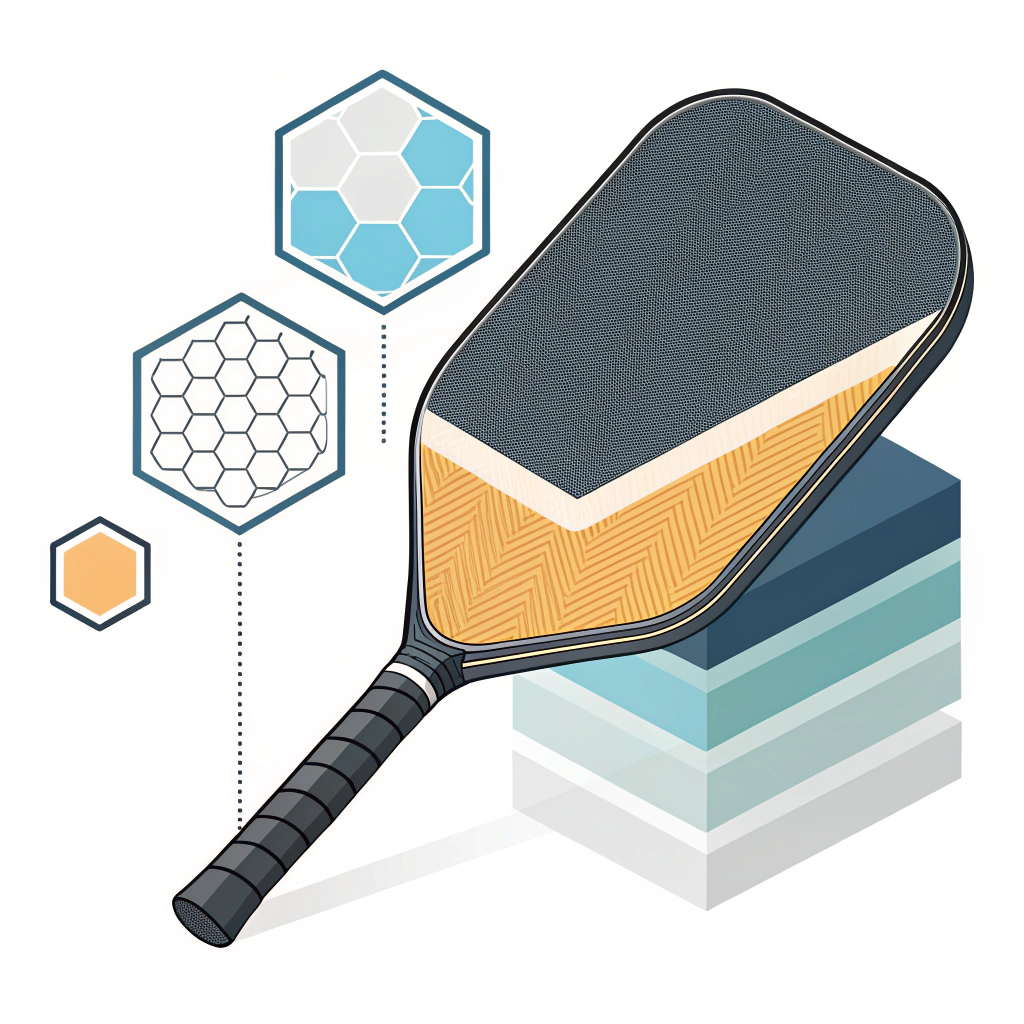
Fast answer (snippet): For B2B procurement, prioritize a paddle specification that pairs a carbon-fiber1 or high-grade composite2 face with a sealed polymer or Nomex honeycomb core3, manufactured by controlled hot- or thermoforming4 processes and validated by impact, cyclic fatigue, and delamination5 tests. That combination gives the best balance of lifespan, predictable failure modes, and manageable warranty/TCO.
Executive summary (key takeaway for spec and sourcing teams)
- Specify face material and core as a system: 3K/T300/12K carbon faces or carbon–fiberglass composites over a polymer or Nomex honeycomb core deliver the best longevity across player segments.
- Require supplier certifications for press profiles, adhesive system, edge sealing, and batch test reports (impact, peel, abrasion, cyclic).
- Use TCO modelling: higher upfront cost for hot-pressed carbon paddles often reduces returns and warranty costs for club and tournament skus, while polymer-core fiberglass paddles are cost-effective for recreational lines.
Why durability matters for B2B buyers
Durability drives total cost of ownership, warranty exposure, and brand reputation. A paddle that fails in months increases returns, logistics costs, and customer churn; a consistently durable product reduces replacement volume and protects margins.
For distributors and OEMs, predictable failure behavior matters as much as mean-time-to-failure. Knowing common failure modes lets you write precise warranty thresholds and inspection checkpoints that reduce dispute volume and improve after-sales handling.
Core determinants of paddle longevity
Quick checklist — inspect and require specifications on each item below:
- Face material: stiffness, abrasion resistance, crack resistance → affects impact and surface wear.
- Core type: energy return, fatigue life, moisture sensitivity → affects internal collapse and feel.
- Adhesive system: shear and peel strength, cure protocols → affects delamination risk.
- Manufacturing process: press temperature/pressure profile, cycle control → affects internal stresses and bonding.
- Edge protection & sealing: mechanical guard or full-seal → prevents moisture ingress and edge delamination.
- Surface finish & coatings: abrasion resistance, UV stability, print durability.
- Grip & handle construction: sweat/heat tolerance, glue joints, endcap sealing.
Implications: Weak adhesive or poor edge sealing increases delamination and core moisture ingress; inappropriate press profiles cause internal residual stress and early cracking.
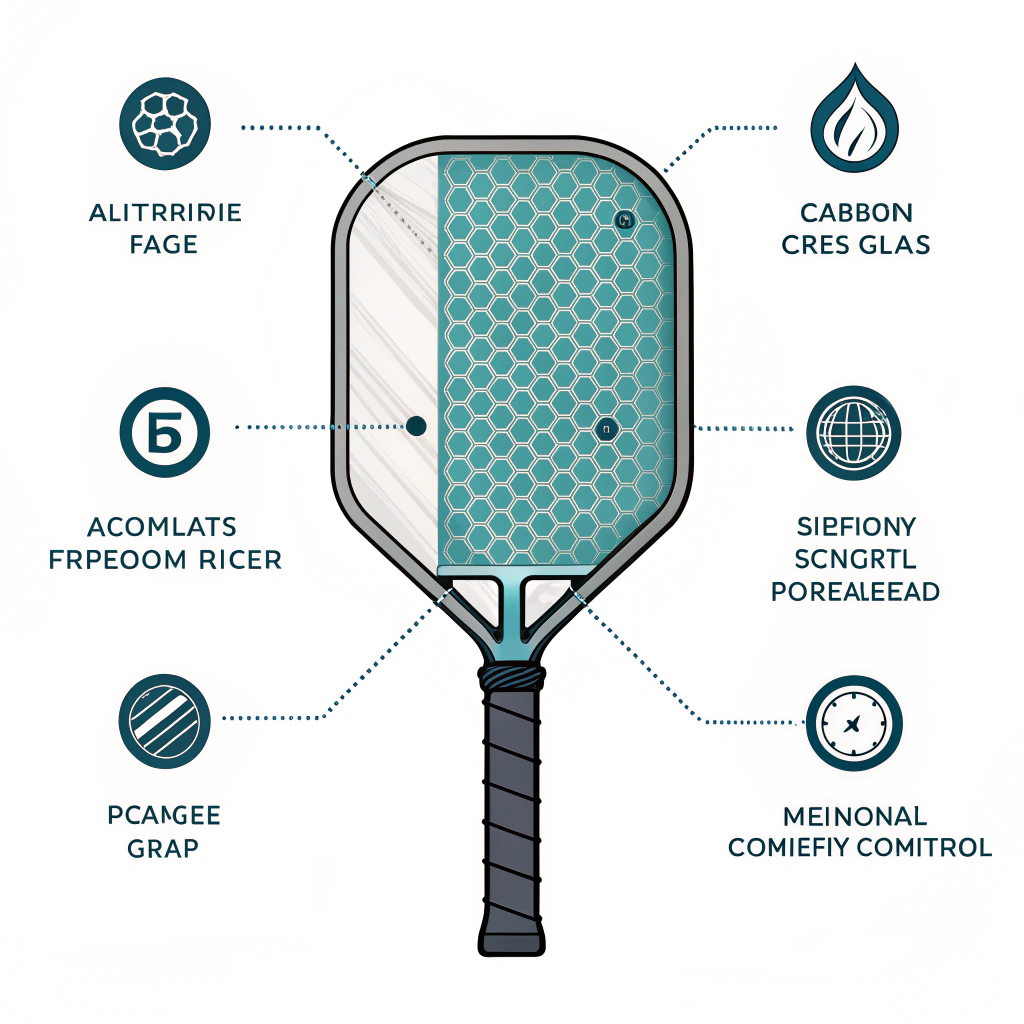
Material deep dive: face sheets (3K, 12K, T300 carbon; E-glass)
Overview table — stiffness, impact behavior, abrasion resistance, relative cost per paddle (indicative)
| Material | Stiffness/feel | Impact tolerance | Abrasion resistance | Relative cost |
|---|---|---|---|---|
| 3K Carbon Fiber | Medium-high, slightly flexible | Good — flex absorbs shock | High | Mid |
| 12K Carbon Fiber | High stiffness, firmer feel | Excellent impact resistance | Excellent | High |
| T300 Carbon Fiber | High tensile strength, balanced feel | Very good, high fatigue strength | Very good | High |
| E-Glass (Fiberglass) | Softer, more forgiving | Moderate — bends before cracking | Moderate | Low |
Key points:
- 3K carbon: best balance of power and control. Good for mid/high-level paddles where some flex increases sweet-spot tolerance.
- 12K carbon: denser weave, harder surface, best abrasion and impact durability — suited to high-end tournament products where surface longevity and hardness are required.
- T300: engineered for tensile strength and fatigue resilience; ideal when you need a lightweight but durable face.
- E-Glass (fiberglass): greatest cost advantage and larger sweet spot, but shorter life under aggressive players due to lower surface hardness.
First-use note: bold terms above denote first appearance of important keywords.
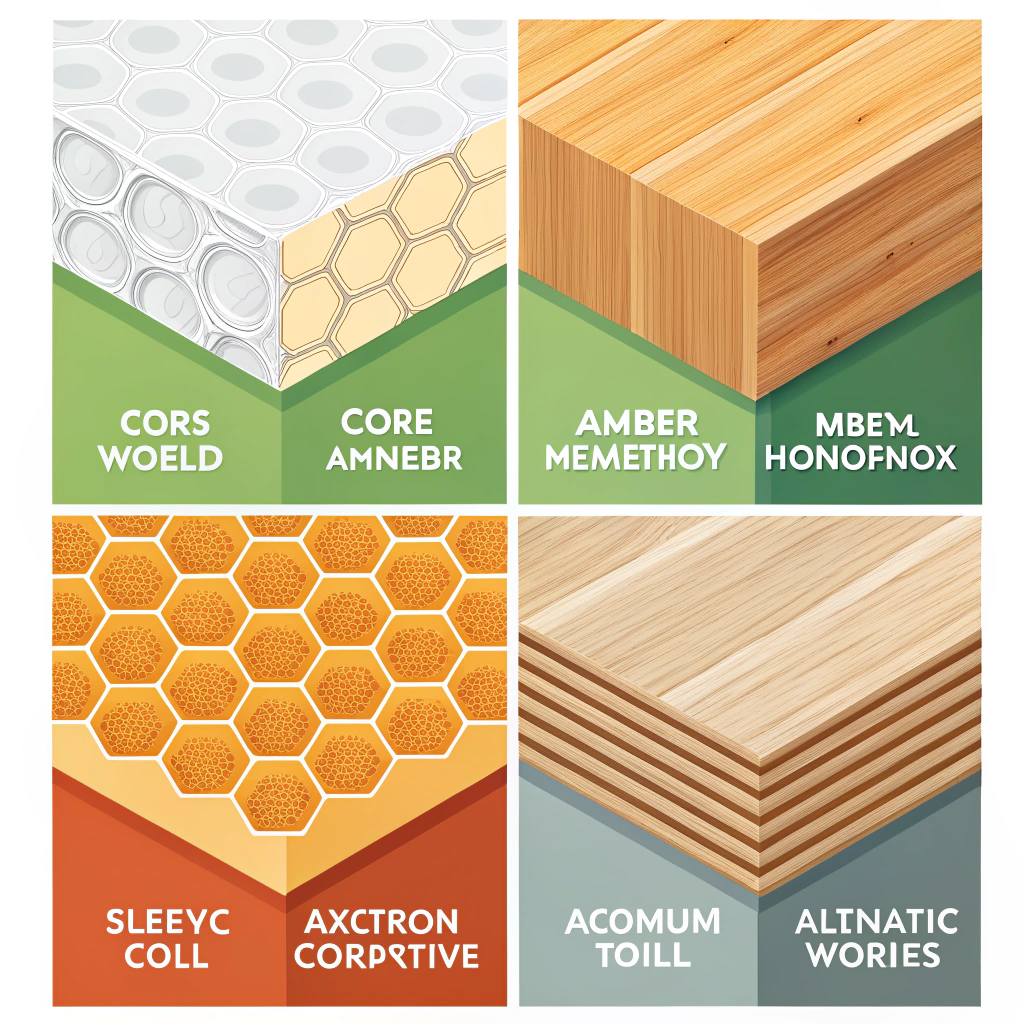
Core materials compared: Nomex, polymer, aluminum honeycomb, bamboo composite
Short performance matrix:
- Nomex honeycomb (aramid): high stiffness, excellent heat tolerance, long fatigue life, low moisture uptake. Hard, crisp feel. Repairability: limited; when core breaks, paddle is typically replaced.
- Polymer honeycomb (e.g., polypropylene/pulp blends): better elasticity, reduced vibration, good fatigue resistance, lower density; more forgiving for recreational players. More tolerant to minor impacts.
- Aluminum honeycomb: balanced weight and strength, good energy return, sensitive to dents from point impacts; risk of corrosion if edge seal fails.
- Bamboo composite: natural feel, high impact resistance, environmentally friendly; moisture sensitivity depends on resin systems and sealing.
Fatigue life ranking (general): Nomex ≥ Aluminum ≈ Polymer > Bamboo (depends on resin). Moisture sensitivity ranking: Polymer (best) > Nomex > Aluminum (requires seal) > Bamboo (worst without strong sealing).
Manufacturing process effects: hot pressing vs cold pressing vs thermoforming
Process impacts durability and production economics:
- Hot pressing
- Benefits: strong bond lines, excellent consolidation for high-temp adhesives/resins, high throughput for volume runs.
- Durability: lower delamination risk if controlled; high impact resistance.
- Trade-offs: potential change to resin properties (stiffer feel), higher capex.
- Cold pressing
- Benefits: retains raw material mechanical properties, better ball feel control, lower thermal stress.
- Durability: good for layered constructions; may show weaker interlaminar bonding if adhesive cure incomplete.
- Trade-offs: longer cycles, tight pressure control required, lower throughput.
- Thermoforming
- Benefits: precise geometry control, excellent for asymmetric or sculpted heads, good thickness distribution.
- Durability: excellent if mold/heat profile optimized; good for hybrid materials.
- Trade-offs: higher cost per unit, slower for large batches.
Manufacturing checklist for RFP: press temperature/pressure profile logs, adhesive cure curve, post-cure schedule, tooling tolerances, sample peel tests per batch.
Common failure modes and root causes
- Delamination (face-to-core or plies): causes — inadequate adhesive, incorrect cure profile, edge damage allowing moisture ingress. Typical timeline: months to 2 years, accelerates with impacts.
- Surface abrasion and wear: causes — low hardness faces, poor abrasion coatings, heavy spin play. Timeline: months for high-use club paddles.
- Core collapse / cell fracture (honeycomb): causes — repeated high-energy impacts, point damage, moisture expansion. Timeline: months–years depending on core.
- Edge guard cracking / separation: causes — insufficient bonding, impact, thermal cycling. Immediate to months.
- UV/heat aging: causes — inadequate UV inhibitors in resin/print, high storage/transport temperatures. Timeline: years but accelerates in sun-exposed retail displays.
Example failure timeline (typical high-use club paddle):
- 0–3 months: grip wear, surface scuffs.
- 3–12 months: initial surface abrasion, small delamination near edges if edge sealing poor.
- 12–24 months: possible core fatigue symptoms (sound change, loss of stiffness).
Testing protocols & KPIs buyers should require
Minimum test suite and suggested target values (adjust to product tier):
- Impact test (single-edge impact): 10–50 J depending on spec; target: no visible delam or core break at design energy.
- Cyclic fatigue (paddle face, repeat impacts): 10,000–50,000 cycles to representative energy; target: <5% stiffness loss for tournament paddles; <10–15% for recreational paddles.
- Peel/delamination (ASTM D1876-like): peel strength ≥ 3–7 N/mm for high-performance adhesives.
- Abrasion (Taber or equivalent): 1,000–5,000 cycles; target: <15% surface roughness increase for tournament paddles.
- Moisture & temperature aging: 1,000 hours at 70°C and 85% RH; target: <3% dimensional change, no delam.
- UV exposure: 500–2,000 hours accelerated UV; target: no surface craze or adhesive breakdown.
- Ball rebound retention: measure initial vs after ageing; target: ≤5–7% loss for tournament paddles.
Require suppliers to provide raw test data, test setups, and failure photos. If available, request NEX internal test results for similar constructions as benchmark.
Quality control & process controls for suppliers
Actionable checklist for RFPs:
- Incoming material certificates (resin batch, fiber lot, core batch).
- Adhesive datasheets and cure curves; supplier must supply oven/press logs per batch.
- Press profile traceability: temperature, pressure, time recorded and retained 12+ months.
- Edge sealing process: method documented (butt cap, full wrap, acrylic filler) and adhesion tests.
- Batch testing: sample 3–5 paddles per 500 produced for impact, peel, and cyclic tests.
- Nonconformance reporting: method for handling delam returns and corrective action logs.
- Accelerated life testing: supplier to run annual AQL-driven life tests and provide reports.
- Traceability: serial/batch codes, production date, tooling ID.
Include a clause for third-party lab audit rights and sample retention policy.
Design & specification tips to extend life — do/don't list
Do:
- Specify edge guard minimum thickness and bond method (adhesive + mechanical wrap).
- Use a balanced weight distribution (within ±5g tolerance) to avoid stress concentrations.
- Select surface treatments: ceramic or hard-coat for high abrasion resistance.
- Define grip materials with sweat-resistant adhesives and sealed endcap.
- Allow slight face flexibility (controlled by core choice) to reduce high-stress point failures.
Don't:
- Over-specify extreme stiffness for recreational paddles — leads to brittleness in high-impact play.
- Accept edge sealing only via cosmetic glue; require mechanical retention or full perimeter seal.
- Ignore adhesive system — mismatched adhesive/resin cures are a leading cause of delam.
Cost vs longevity modelling
Simple example (per 10,000 units, illustrative numbers):
| Option | Unit price | Expected return rate (year 1) | Replacement cost (warranty) | TCO (unit+warranty%) |
|---|---|---|---|---|
| Fiberglass polymer core | $10 | 8% | $800 | $10 + $0.64 = $10.64 |
| Cold-pressed 3K carbon/poly core | $18 | 4% | $400 | $18 + $0.72 = $18.72 |
| Hot-pressed 12K carbon/Nomex | $28 | 1.5% | $150 | $28 + $0.42 = $28.42 |
Interpretation: spending more upfront on hot-pressed carbon with Nomex can reduce warranty and return handling costs. For club/tournament SKUs the higher upfront cost often justifies reduced logistics, replacement inventory, and brand risk.
Include assumptions: replacement cost reflects logistics and admin; adjust to your internal handling cost.
Case studies / real-world data (NEX internal test results labeled)
- Hot-pressed 12K carbon face + Nomex core vs cold-pressed 3K carbon + polymer core — 12-month field trial (NEX internal data)
- Units: 2,000 each to club-level distribution
- Delamination rate: 12K/Nomex = 0.8%; 3K/poly = 3.6%
- Stiffness retention after 12 months: 12K/Nomex = –2%; 3K/poly = –6%
- Return rate: 12K/Nomex = 1.1%; 3K/poly = 4.2%
- Thermoformed carbon/fiberglass hybrid with full perimeter seal — 6-month accelerated lab test
- Abrasion cycles to visible degrade: >3,500 (Taber)
- Peel strength after UV aging: retained 92% of initial
- Result: minimal edge delamures during field deployment in humid climates.
These examples indicate process+material combos matter as much as raw material selection.
Supplier questions & contract clauses (quick bullets for RFPs)
- Provide press profile logs (temperature/pressure/time) per batch for inspection.
- Deliver batch test report with impact, peel, and cyclic fatigue numbers.
- Warranty: define acceptable failure thresholds (e.g., delamination >10mm seam = warranty) and response time (30 days).
- On-demand print durability clause: prints must pass 500 cycles abrasion and 200 hrs UV with ≤10% color fade.
- Sampling plan: X per Y units (e.g., 3 per 500) tested and retained for 6 months.
- Penalty clause: if batch fails lab test, supplier reworks/replaces at supplier cost.
- Third-party lab audit rights within 60 days of delivery.
Conclusion & recommended spec baseline for different customer tiers
- Recreational (mass-market): E-glass face, polymer honeycomb core, cold-pressed acceptable. Target life: 12–18 months high use. Warranty: 6–12 months.
- Club (high use, rental programs): 3K carbon or carbon–fiberglass composite face, polymer or aluminum honeycomb, thermoforming or controlled hot-press. Target life: 18–36 months. Warranty: 12 months with defined failure thresholds.
- Tournament/Pro: 12K or T300 carbon face, Nomex or aluminum core, hot-pressed or optimized thermoforming, full edge seal and hard-coat finish. Target life: 36+ months. Warranty: 12–24 months with stringent batch testing.
Call-to-action
Request lab reports and a sample test batch before awarding volume. Ask suppliers for production traceability and press logs. Contact NEX Pickleball to arrange custom durability trials, sample pilot runs, and comparative lab testing.
People Also Ask
Q: Which pickleball paddle lasts the longest?
A: Paddles with carbon fiber faces combined with robust honeycomb cores (Nomex or high-density polymer) generally last the longest. Longevity depends on face weave (12K/T300 are most durable), core sealing, and manufacturing control. Require impact and cyclic fatigue data to confirm supplier claims.
Q: Why do pickleball paddles not last?
A: Common reasons are delamination (due to poor adhesive cure or edge damage), surface abrasion (low hardness faces or no hard-coat), core cell failure (repeated point impacts or moisture ingress), and edge-guard failure. Inadequate manufacturing controls and missing edge sealing accelerate these failures.
Q: What is the most durable pickleball paddle surface?
A: High-density carbon fiber faces (12K or T300) deliver the best durability. They offer high abrasion resistance, strong impact tolerance, and better fatigue life compared to fiberglass. Durability still depends on bonding, edge protection, and surface coatings.
-
carbon-fiber: Read the article to learn about carbon fiber weave types, tow sizes (3K/12K/T300), resin compatibility, and how these factors affect stiffness, impact tolerance, and supplier QC — information that helps sourcing teams specify and evaluate face sheets. ↩ ↩
-
composite: The linked content explains what “composite” faces mean (layering of carbon, fiberglass, and resins), trade-offs between hybrid layups, and sourcing considerations such as ply schedule and interply bonding that directly impact durability and feel. ↩ ↩
-
Nomex honeycomb core: Learn why Nomex (aramid) cores offer high heat tolerance and fatigue life, how cell size/density influence performance, and procurement tips (certs, batch testing, repairability limits) useful for specifying cores. ↩ ↩
-
thermoforming: This resource outlines thermoforming vs hot/cold pressing, tooling needs, process controls (heat/pressure profiles), and when thermoforming improves thickness distribution and durability — key for RFP process and cost/quality trade-offs. ↩ ↩
-
delamination: The linked material covers what delamination is, root causes (adhesive cure, edge ingress, thermal stress), test methods and acceptance thresholds, and what failure evidence buyers should require from suppliers and labs. ↩ ↩