Skip to content

Short answer — Yes: a textured surface (properly designed and manufactured) reliably increases spin potential and player-perceived control, but the right choice depends on target player level, manufacturability, durability targets, cost tolerance, and tournament certification requirements. Below is a practical comparison and an OEM-ready spec-and-test playbook to help sourcing and product teams decide whether to make textured faces standard or optional.
Why this matters for sourcing managers
- Textured faces change three things that matter commercially: on-court performance (spin), product claims (marketing differentiation), and manufacturing complexity/cost.
- Your decision must balance measurable spin gains against durability risk, production throughput, and the need for USAPA/ITF1 style certification if you target tournament players.
Core physics in plain terms
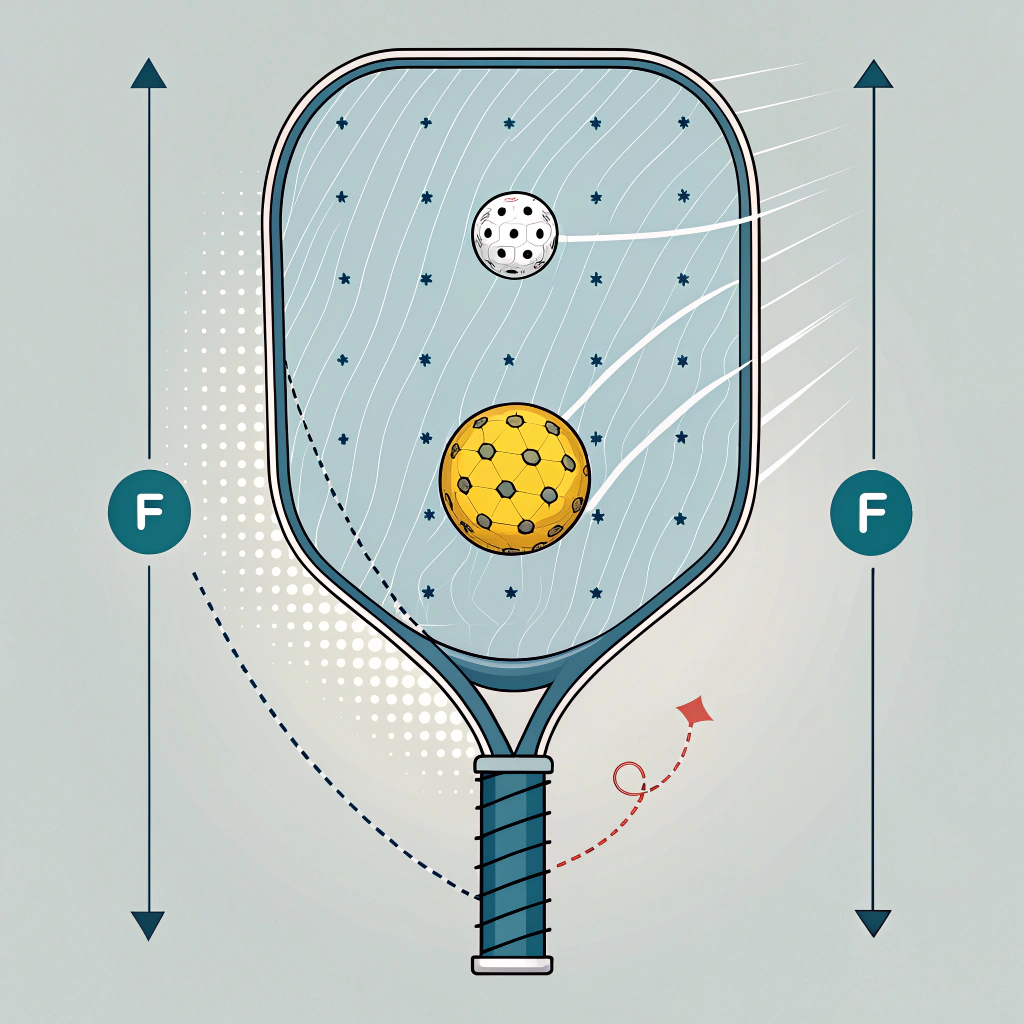
- Spin increases because surface microtexture increases the friction coefficient and effectively increases dwell time2 — the brief contact time between ball and face. Higher friction and dwell time let the paddle “grab” the ball more before it leaves, producing more angular velocity (spin).
- Microtexture also changes local contact geometry: more asperities (microscale peaks) concentrate pressure and enhance tangential force transfer without needing large macro-roughness that harms control.
- Magnus effect amplifies the on-court result: more initial spin creates greater air-driven curve and dip.
- Key measurable parameters: surface roughness (Ra)3 in micrometers, coefficient of friction (µ), and dwell time (ms) under a standardized impact profile.
Comparison: textured options and manufacturability
Use this decision table to align performance goals with production capability and cost:
| Method | Typical Ra range (µm) | Expected spin uplift vs smooth* | Manufacturability | Durability | Relative cost impact |
|---|---|---|---|---|---|
| Laser etch (micro-grooves/quilting) | 1.5–6 | Medium–High | High precision; good for small batches; digital control | High if depth controlled | +10% to +25% |
| Molded microtexture4 (tooled faces) | 0.8–5 | Low–Medium | Best for high volume; one-time tooling | Very high | +5% to +15% |
| Coated grit (polymer binder + abrasive) | 3–10 | High | Post-process application; variable | Medium; grit loss risk | +15% to +35% |
| Sandblasting | 2–8 | Medium | Simple but less controlled | Medium | +5% to +20% |
| Abrasive surface laminates (composite with gritty layer) | 2–7 | Medium–High | Requires supplier alignment on layup | Good | +8% to +20% |
*Spin uplift estimates are lab-relative vs a comparable smooth surface and depend strongly on ball type and shot mechanics.
Key practical notes:
- Molded microtexture is the most consistent for high volume and offers the best durability-to-cost ratio. It requires upfront tooling but minimal per-unit time.
- Laser etch gives design flexibility for targeted patterns (e.g., directional grooves for topspin), but can increase cycle time and capital cost.
- Coated grit can produce the highest immediate spin but risks grit shedding and increased abrasiveness that may affect ball wear and certification.
Recommended OEM specs to include in RFQ
Provide concise, testable requirements in your purchase order. Example spec block:
- Face material: Carbon fiber (3K/12K/T300) or E-glass composite — supplier to confirm compatibility with chosen texture method.
- Target surface roughness (Ra): specify range (e.g., 2.5–5.0 µm for medium texture; 5.0–8.0 µm for high texture).
- Static friction coefficient (ball–face) target: µs = 0.35–0.55 (medium) or µs = 0.55–0.75 (high).
- Texture uniformity: ±10% Ra across hitting surface; no localized spikes > +25% Ra.
- Adhesion (for coated surfaces): cross-cut adhesion > 4B (ASTM D3359) or equivalent.
- Abrasion resistance: Taber abrasion (ASTM D4060)5 < 10% loss in friction after 1,000 cycles (specify wheel type and load).
- Edge/face bonding: no delamination after 50 impact cycles at 1.5 J (or equivalent internal test).
- Process compatibility: confirm hot-press/cold-press/thermoform parameters if texture applied pre-press.
Include these as pass/fail in contracts so suppliers provide objective test data.

Recommended test protocol (lab-level and production QA)
-
Surface characterization
- Tool: contact/non-contact profilometer. Report average Ra, Rz, and 3D areal texture parameters (Sa).
- Sampling: measure at 9 points (center + 8 around) and report mean ± SD.
-
Friction & dwell test
- Use a standardized drop-impact rig or robot arm to strike the ball at fixed impact speed (e.g., 30–40 mph equivalent) and measure tangential impulse and contact time via high-speed camera.
- Report µs and dwell time (ms). Compare to reference smooth paddle from same line.
-
Spin performance test
- Use a ball launcher and high-speed tracking (or spin-measuring radar). Record RPM achieved on standardized drives and serves.
- Test with two representative ball types (indoor vs outdoor polymer). Run 30 shots and report median RPM and coefficient of variation.
-
Durability tests
- Taber abrasion (ASTM D4060) for coated textures.
- Adhesion (ASTM D3359).
- UV and humidity aging (e.g., 96–500 hours UV exposure) then re-test friction and Ra.
- Ball-wear interaction: perform 500-cycle rally test with robotic arm; inspect balls and paddle surface for degradation.
-
Safety & compliance
- Verify paddle size/weight and confirm no excessive texture that may breach tournament rules. If you intend to market as tournament-legal, require supplier to support USAPA certification.
Pass criteria (example):
- Ra within target ±10%
- Friction retention >90% after 1,000 abrasion cycles
- Spin uplift >15% for medium texture vs smooth baseline
- No delamination or visible grit loss after rally test
Durability, balls, and marketing implications
- Textured faces increase ball wear — communicate with marketing to avoid claims that imply extended ball life.
- Coated grit options tend to shed fastest; molded texture and laser etch are best for long-term consistency.
- If you sell to tournament players, require supplier to submit test samples for USAPA evaluation. Do not claim "tournament-approved" until certification is complete.
- Sample marketing claims that are factually safe: “Engineered microtexture for increased spin (lab-tested)” with a link to the lab method; avoid specific percentage claims unless you can guarantee reproducible lab and in-market results.
Cost & production lead-time considerations
- Upfront tooling (molded texture) is efficient at scale: typical ROI achieved after 5–20k units depending on margin.
- Laser etch offers low tooling but higher per-unit time; good for limited SKUs or premium lines.
- Coated grit has fastest time-to-market for retrofitting an existing line but can increase returns due to surface wear.
- Expect per-unit cost increase roughly:
- Molded microtexture: +5–15%
- Laser etch: +10–25%
- Coated grit: +15–35%
Exact numbers depend on region, batch size, and whether texture is integrated into layup or applied post-press.
Decision guide: when to make texture standard vs optional
-
Make textured faces standard when:
- Your brand targets intermediate–advanced players and premium/retail margins support +10% cost.
- You can invest in tooling or supplier partnerships for consistent production.
- You require a strong spin-based marketing differentiation.
-
Offer texture as an optional upgrade when:
- You serve a broad beginner market where cost sensitivity and durability are priority.
- You have multiple SKUs and want a low-risk way to test market response (use laser etch or coated grit for pilot SKUs).
-
Avoid textured surfaces or limit texture when:
- Your priority is maximum ball life and minimal ball wear (e.g., rental or community courts).
- You must guarantee tournament legality in all SKUs without managing certification processes.
Practical next steps for sourcing teams
- Define target player segment and acceptable cost uplift.
- Pick 1–2 texture methods to pilot (recommend molded microtexture + laser etch for premium).
- Add the OEM spec block and test protocol to your RFQ and require sample test reports.
- Run a 1,000–5,000 unit pilot, including field trials with target customers and lab retests after aging.
- If intended for tournament play, request supplier assistance for USAPA certification early.
People Also Ask
What pickleball paddle surface is best for spin?
- A composite face with a controlled microtexture typically produces the best spin. Methods like textured graphite, laser-etched micro-grooves, or polymer coatings with fine grit all increase the friction and dwell time that produce spin. The best choice depends on durability and manufacturability: molded microtexture and laser etch give consistent results with better longevity than loose grit coatings.
Are smooth or rough paddles better for pickleball?
- Rough (textured) paddles generally provide more spin, especially for advanced players who use spin-heavy shots. Smooth faces favor consistency and are easier for beginners to control. A medium textured surface often balances spin and control, while highly textured faces maximize spin but may increase ball wear and require stricter QA.
Are textured pickleball paddles legal?
- Textured paddles are legal for most play, but tournament approval requires compliance with specific rules on materials, size, weight, and the amount of texture. If tournament legality is a goal, require your supplier to support USAPA (or relevant body) testing and certification before labeling or marketing the paddle as tournament-legal.
-
USAPA/ITF: Read this to understand the different tournament bodies (USAPA, ITF), their certification processes, and what tests/limits matter when claiming "tournament-legal"—critical for procurement requirements and marketing compliance. Return to text ↩
-
dwell time: Learn how contact duration is measured in impact tests, how it interacts with surface texture to affect spin, and what lab setups reliably reproduce in-market play so you can spec repeatable test protocols. Return to text ↩
-
surface roughness (Ra): Useful reference on how Ra is measured (contact vs non-contact), what Ra ranges mean in practice for spin vs wear, and which are realistic to specify for composite faces. Return to text ↩
-
Molded microtexture: The linked material explains tooling approaches, surface fidelity limits, and cost amortization models for integrating microtexture into a mold—helpful for evaluating upfront investment vs per-unit benefits. Return to text ↩
-
Taber abrasion (ASTM D4060): Background on the Taber test method, how to specify wheels/load/cycles, and how to interpret percent-loss metrics for textured coatings versus molded textures in QA. Return to text ↩