Skip to content

Short answer
A practical paddle durability protocol combines: (1) a factory QC checklist covering materials, pressing and bonding parameters; (2) lab tests adapted from ASTM/ISO methods for impact resistance, flexural fatigue1, surface abrasion, edge-guard adhesion and core collapse; and (3) a controlled on-court validation. Use statistically defensible sampling ( ANSI/ASQ Z1.42 / ISO 2859), defined pass/fail thresholds (e.g., <2 mm permanent core collapse, AQL3 1.5, >80% retained flexural strength after cyclic loads, no delamination), and correlate lab failures with field failure modes to set supplier acceptance and warranty terms.
Problem description
Buyers—quality managers and product engineers—need repeatable, measurable tests to decide whether a paddle design or supplier meets durability expectations. Marketing claims (e.g., “high-durability carbon”) are insufficient. You need:
- Clear, repeatable test protocols
- Equipment and sample-size guidance
- Pass/fail thresholds tied to failure modes (delamination, core collapse, edge separation, abrasion, handle failure)
- A sampling plan for supplier acceptance and warranty risk quantification
Root-cause view of common failures
- Delamination / blistering: poor resin cure, contamination, inadequate pressure/temperature profile during hot pressing or thermoforming
- Core collapse: low-density or inadequate core material or poor bonding between face sheet and core
- Edge guard adhesion failure: improper surface prep or under-cure of adhesive
- Surface abrasion / smooth face: poor wear-resistance of surface material or insufficient topcoat
- Handle tensile / grip failure: weak glue line, inadequate shank insert, or poor overmolding control
Understanding each failure mode guides which tests to run and what acceptance criteria to set.
Recommended test suite (overview)
Run this core battery for supplier validation and pre-production signoff:
- Visual & dimensional inspection (100% for incoming samples)
- Mass & balance check
- Surface hardness (durometer)
- Edge-guard adhesion (peel / T-peel)
- Face-to-core delamination test (flexural fatigue + peel)
- Impact resistance (instrumented impact / drop-weight)
- Flexural fatigue (cyclic bending)
- Surface abrasion (Taber or linear abrasion)
- Core crush / compression and permanent set
- Handle tensile / pull-off and torsion
- Accelerated aging (thermal cycling + humidity)
- On-court play trial (standardized field protocol)
Below are protocols, equipment, sample-size guidance and recommended pass/fail thresholds for each.
Sampling plan and lot acceptance
Use ANSI/ASQ Z1.42 or ISO 2859 for lot sampling. Example for initial supplier validation and pre-production:
- Prototype run or small lot (≤1,000 pcs): test n = 30 (random)
- Production batch 1,000 – 10,000: use AQL3 1.5, sample per standard (typically n≈50–80)
- Production batch >10,000: AQL3 1.5, sample appropriately (n≈80–125)
For destructive tests (impact, flexural fatigue), split the sample set:
- Non-destructive: 50% of selected samples (visual, mass, hardness, balance)
- Destructive: 50% (impact, fatigue, peel). For statistical confidence, test at least 10–15 units for each destructive test per lot during validation; for routine production, test 3–5 units per shift.
Record and retain tested samples to correlate failures with process data (press cycle, resin lot, operator).
Equipment & materials list (minimum)
- Digital calipers, micrometer, and digital scale
- Shore D durometer (ASTM D22404)
- Taber Abraser5 (ASTM D4060) or linear abrasion rig
- Instrumented drop-weight impact tester or pendulum (ISO 179 / Charpy adaptations)
- Mechanical fatigue test rig capable of cyclic bending at 1–3 Hz with fixture for paddle geometry (adapt ASTM D7774-style cyclic flex tests)
- Universal testing machine (UTM) with tensile grips (for handle pull-off at controlled crosshead speeds)
- Peel test fixture (T-peel; ASTM D1876)
- Compression platen with displacement measurement (for core collapse)
- Environmental chamber for thermal cycling and humidity aging
- High-resolution camera for visual documentation and delamination imaging

Test protocols and acceptance criteria (detailed)
- Visual & dimensional inspection (100% on sample)
Purpose: detect cosmetic defects and manufacturing inconsistencies.
Procedure:
- Inspect for edge chipping, blistering, bubbling, surface finish inconsistencies, and glue squeeze-out.
- Measure overall length, width, thickness at three standard points, and handle length.
Acceptance: - Dimensional tolerance: ±1.5 mm unless otherwise specified.
- No visible delamination, blistering, or uncured resin; acceptable cosmetic defects defined per agreed reject criteria.
- Mass & balance
Purpose: verify weight spec and swing-weight consistency.
Procedure:
- Weigh each sample to 0.1 g.
- Measure balance point (distance from butt) using a balance jig.
Acceptance: - Mass tolerance: ±3% of nominal for production; ±1% for premium lines.
- Balance within ±5 mm of spec.
- Surface hardness (Shore D)
Procedure: ASTM D2240, three readings across the face center and average.
Acceptance:
- Consistency ±5 points; use baseline spec from material (e.g., 60–75 Shore D depending on surface material).
- Edge-guard adhesion (T-peel)
Procedure:
- Prepare a sample with edge guard; clamp and pull at 300 mm/min following ASTM D1876 adapted for curved geometry.
Acceptance: - Peel strength >10 N/cm (recommendation); no cohesive failure of the face laminate. Failure mode should be adhesive (edge guard to adhesive) rather than laminate delamination.
Rationale: Low peel strength correlates to edge peeling in field use.
- Delamination / face-to-core bond (flexural fatigue + peel)
Purpose: accelerate face-core separation.
Procedure:
- Use cyclic bending fixture: clamp handle, apply cyclical deflection at paddle tip for 100,000 cycles at 1–2 Hz and a maximum deflection equivalent to 60% of the paddle’s static deflection at service load.
- After cycles, perform visual inspection and conduct localized peel tests at suspected points.
Acceptance: - No delamination >10 mm in any direction.
- Retained flexural stiffness ≥80% of initial.
Rationale: High-cycle fatigue reproduces micro-crack growth from repeated impacts.
- Impact resistance (drop-weight or instrumented impact)
Procedure:
- Use a 5 J and 10 J impact energy level (adjustable based on target market). For each energy level, impact 5 locations across the face (center, upper, lower, left, right).
- Instrument to measure peak force and displacement.
Acceptance: - No through-thickness crack, no core crushing >2 mm localized indentation.
- No visible delamination >10 mm.
- Residual stiffness drop ≤20%.
Rationale: These energies represent accidental high-energy strokes or racket-to-racket contact during play.
- Surface abrasion (Taber Abraser)
Procedure:
- ASTM D4060 with CS-10 wheel, 500 cycles, 1 kg load. Measure mass loss or change in surface roughness.
Acceptance: - Mass loss ≤0.5% of paddle face mass or Δsurface roughness (Ra) ≤10% depending on starting smoothness.
- Ball rebound and spin characteristics should not degrade beyond defined limits (see on-court test).
- Core crush / compression
Procedure:
- Place paddle between flat platens, compress to 2 kN at 5 mm/min, hold 1 minute, release. Measure permanent set after 1 min and 24 hrs.
Acceptance: - Permanent set (depth of crushed zone) ≤2 mm at center for premium paddles, ≤3 mm for recreational lines.
- No face-to-core separation.
- Handle tensile / pull-off
Procedure:
- Clamp paddle shaft in UTM and apply axial tensile or torsional load at 50 mm/min until failure.
Acceptance: - Tensile pull-off strength ≥200 N for recreational; ≥400 N for high-performance (adjust to contract).
- Failure mode: handle material or shank failure; no adhesive joint failure at grip-to-handle for high-quality paddles.
- Accelerated aging — thermal & humidity cycling
Procedure:
- Cycle between -10°C and +60°C for 10 cycles with 95% RH soak for 48 hours at high temp.
- After aging, repeat visual, impact, and peel tests.
Acceptance: - No new delamination or blistering. Functional thresholds as per respective tests.
- On-court play validation (field simulation)
Procedure:
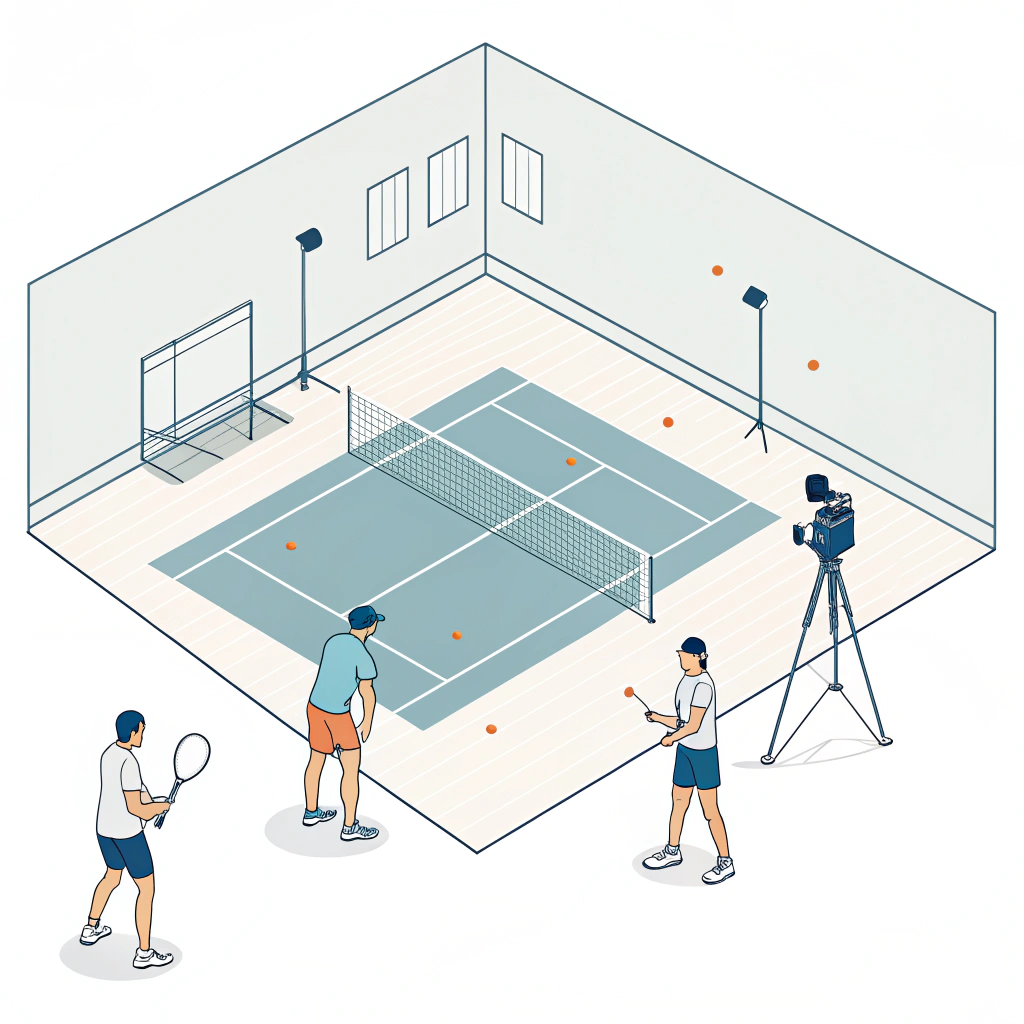
- Use a standardized play protocol: 10 trained players, each player performs 500 returns in a controlled court environment hitting a target pattern, with rotation to equalize wear. Record time and ball count until first visible functional failure or until 5,000 hits per paddle.
Measurements: - Ball rebound height from fixed drop test pre/post field test.
- Spin (qualitative or using a spin-measure device).
- Visual inspection for edge guard separation, face wear, and cracks.
Acceptance: - No critical failure (broken frame, severe delamination) within 5,000 hits for premium paddles.
- Functional performance (rebound, feel) retained within ±10% of baseline.
Factory QC checkpoints and process controls
Implement these inline checks to reduce lot failures:
- Incoming raw material certificates (resin cure curve, carbon fiber weave type): keep batch traceability.
- Resin mixing ratio verification and viscosity checks.
- Press cycle records (temperature profile, hold time, pressure): store for each press cycle.
- Core inspection prior to lamination for honeycomb regularity and adhesives applied.
- Edge guard application process verification: surface activation (plasma or solvent), adhesive batch, cure schedule.
- Adhesive and glue-line thickness measurement (target ±10 μm).
- Random destructive checks after each press shift (1–2 paddles) for bond integrity.
- Operator training and SPC (statistical process control) charts for key process variables.

Failure-mode analysis & correlating lab to field
When a paddle fails in the field:
- Capture the failed unit and document use history.
- Run the full lab suite to reproduce failure (impact, peel, fatigue).
- Compare process records (press cycle, resin lot, operator).
- Classify failure: material defect, process deviation, or misuse.
- Update supplier corrective action (SCAR) with root cause, containment, and preventive actions.
Case example (summary)
A brand received complaints of edge peeling after 3 months in retail. Lab T-peel showed edge adhesion of 6 N/cm (below acceptance). Process audit revealed missing primer application and reduced press dwell. Corrective actions: reintroduce surface activation, change adhesive lot, and add a final peel test on each edge-guarded batch. Post-correction: adhesion improved to 14 N/cm and field complaints dropped to zero in the next 12 months.
How to set warranty and acceptance thresholds
- Use lab-to-field correlation data: if 10,000 hits in lab fatigue corresponds to 2 yrs typical amateur play, you can set a 2-year limited warranty for premium paddles.
- Define clear return-for-analysis procedures and failure classification criteria (normal wear vs. manufacturing defect).
- Use AQL-based acceptance for production, but require 0% critical defect allowance (e.g., no structural failures) in first article inspection.
Quick-reference table: Tests, equipment and recommended pass criteria
| Test | Equipment | Sample size (validation / routine) | Recommended pass criteria |
|---|---|---|---|
| Visual & dimensions | Calipers, scale | 30 / 100% sample check | Dim tolerance ±1.5 mm; no delam/blisters |
| Edge-guard peel | UTM w/ peel fixture | 10 / 3–5 | Peel >10 N/cm; adhesive failure only |
| Flexural fatigue | Cyclic bending rig | 10–15 / 3 | 100,000 cycles; retained stiffness ≥80% |
| Impact | Instrumented impact tester | 10 / 3 | No through-thickness crack; indent ≤2 mm |
| Surface abrasion | Taber Abraser | 5–10 / 3 | Mass loss ≤0.5% or ΔRa ≤10% |
| Core crush | Compression platen | 10 / 3 | Permanent set ≤2 mm |
| Handle pull | UTM | 10 / 3 | Pull strength ≥200–400 N |
Implementation checklist for procurement contracts
- Define materials with certified data sheets (carbon fiber type, core density).
- Specify press method (hot-press / cold-press / thermoforming) and critical parameters.
- Add mandatory pre-shipment test report with raw data (impact curves, peel graphs).
- Include sample retention policy and rejection/rework rules.
- Establish warranty terms tied to lab-validated lifespan and on-court correlation.
- Include right-to-audit and corrective action timelines.
Summary and recommended next steps
- Adopt the test suite above for supplier validation and add routine sampling per ANSI/ISO sampling plans.
- Require suppliers to provide process data (press cycles, adhesive batch) for traceability.
- Define pass/fail numeric thresholds in contracts and require failed-sample analysis workflow.
- Run a correlation study: map lab results to a small field trial (e.g., 30 paddles over 6 months) to refine warranty terms.
People Also Ask
How to tell if a pickleball paddle is bad?
Look for specific failure signs: visible delamination (peeling between face and core), large cracks or frame breaks, edge-guard peeling, significant core crushing (indentation visible under load), and a noticeably smooth, worn face that reduces spin control. Functionally, a “bad” paddle often shows reduced rebound, loose or shifting balance point, or handle looseness. For procurement, any structural failure (through-thickness cracks, core collapse >2 mm, delamination >10 mm) should be treated as a manufacturing defect and trigger sample-forensic testing.
-
flexural fatigue: Read the linked guidance to understand how cyclic bending tests simulate repeated play, how to set cycle counts and deflection levels, and how to interpret retained stiffness and delamination risks for supplier acceptance. ↩
-
ANSI/ASQ Z1.4: The reference explains lot-by-lot sampling plans, acceptance criteria tables, and how to apply the standard to incoming paddle lots to balance inspection cost and risk. ↩ ↩2
-
AQL: Learn how Acceptable Quality Level is defined, how to select AQL values for critical vs. cosmetic defects, and how AQL drives sample sizes and contractual acceptance rules. ↩ ↩2 ↩3
-
ASTM D2240: This standard details Shore D hardness testing procedures, calibration, and interpretation—useful for specifying surface hardness tolerances and testing protocols in contracts. ↩
-
Taber Abraser: The equipment/spec guide shows test setup, wheel selection, load/cycle parameters (ASTM D4060), and how to translate mass loss or ΔRa into on-court wear expectations. ↩